LED Track Spotlights Explained: Beam Angles, Applications, and How to Choose the Right Fixture
Introduction
In a commercial rollout, the wrong beam angle can turn a flexible track system into a costly re-aiming problem. LED track spotlights are often specified because they appear flexible on paper: movable heads, repositionable fixtures, and a wide range of beam distributions. In real projects, however, flexibility alone does not guarantee a successful lighting result. Poor beam selection, incorrect fixture spacing, or inadequate aiming can create hot spots, dark zones, glare complaints, weak merchandise contrast, and repeated on-site adjustments.
For retail stores, galleries, hospitality venues, and commercial interiors, track spotlight performance should be evaluated as a complete lighting system rather than as a fixture-only decision. Ceiling height, target illuminance, accent contrast, display geometry, surface reflectance, viewing direction, and future layout changes all affect the final specification. If these factors are not aligned early, the result is often higher labor cost, delayed commissioning, and unnecessary fixture replacement after installation.
Executive Summary
LED track spotlights are selected by matching beam angle, luminous intensity distribution, aiming flexibility, and mechanical stability to the actual project condition. The most important inputs are ceiling height, target size, display type, required accent ratio, glare risk, and future layout flexibility.
In commercial lighting practice, narrow beams are commonly used for focal objects, artwork, mannequins, and longer throw distances. Medium beams are suitable for shelving, counters, wall displays, and mixed commercial use. Wide beams are used for broad targets, softer emphasis, and supplementary ambient support. Exact angle ranges and naming vary by manufacturer, so photometric files, sample testing, and on-site mock-ups should be checked before final rollout.1
Correct specification reduces glare, improves visual focus, supports better merchandising, and lowers the risk of re-aiming or fixture replacement during commissioning.
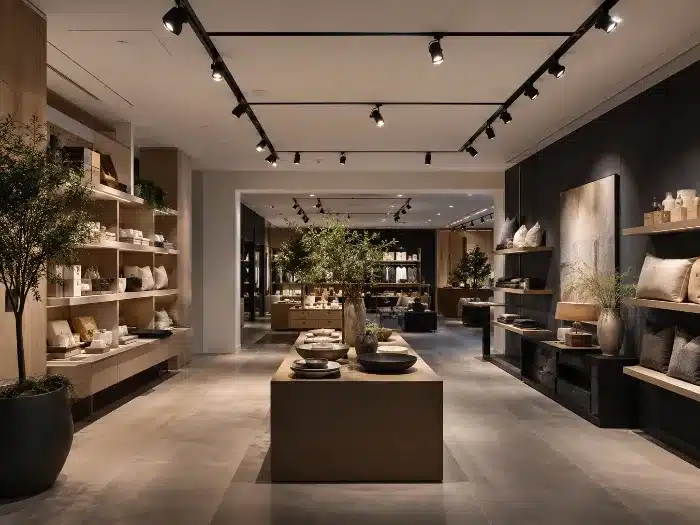
Controlled beam angles help LED track spotlights create clear visual focus in retail displays.
What Is a Track Lighting System?
On-Site / Commercial Reality
In commercial fit-outs, track lighting is often chosen because display layouts rarely remain fixed. Retail shelving changes, gallery exhibits rotate, and hospitality spaces may be re-styled seasonally. A fixed downlight layout can become inefficient when focal points move, while a well-planned track system allows luminaires to be repositioned and re-aimed with less ceiling rework.
Deep Dive & Engineering Solution
A track lighting system is a linear electrified mounting rail that supplies power to compatible luminaires. Track spotlights can be installed, relocated, and aimed along the track as display or task requirements change.
For commercial lighting, the value of a track system lies in three core capabilities:
Positional flexibility
Luminaires can be moved along the track to align with merchandise, artwork, tables, counters, or architectural features.Directional adjustability
The spotlight head can usually rotate and tilt, allowing controlled accent lighting instead of broad general illumination.Beam selection at fixture level
Different beam angles can be used within the same project, which is useful when one space includes wall displays, feature tables, reception counters, decorative surfaces, and circulation areas.
Track systems are most effective when the lighting strategy requires adaptable emphasis, visual hierarchy, and future-proof positioning.
Factory Note
From a manufacturing perspective, track lighting should not be treated as a purely decorative category. In commercial projects, the mechanical stability of the adapter, the consistency of electrical contact, and the aiming friction of the spotlight head all affect long-term service performance. A fixture that drifts after aiming or loses contact intermittently creates immediate maintenance issues on site.
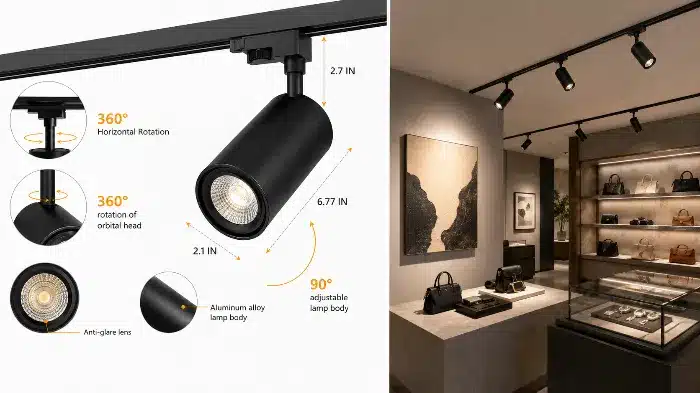
Track lighting system design influences aiming stability and long-term reliability.
How LED Track Spotlights Work
On-Site / Commercial Reality
Installers and specifiers often focus first on wattage and color temperature, but commissioning problems usually come from optical and directional performance. A track spotlight may deliver enough lumens on paper but still fail to highlight a product wall if beam spread, center intensity, distribution, or aiming angle is wrong.
This is why LED track spotlights should not be selected only by lumen output. In real projects, two luminaires with similar lumens can create very different visual results because their beam control, center beam intensity, spill light, color consistency, and glare shielding are different.2
Deep Dive & Engineering Solution
LED track spotlights combine a directional LED source with a reflector, lens, or hybrid optical assembly to control beam shape and luminous intensity distribution. The fixture is mounted on an electrified track adapter and can usually rotate horizontally and tilt vertically.
Their lighting performance depends on four linked factors:
Beam angle
Beam angle describes the angular spread of the main beam. It affects the size of the illuminated area and the concentration of light on the target.3Luminous intensity distribution
This describes how light is delivered in different directions. A fixture with tighter optical control can create stronger emphasis even when total lumen output is similar.Aiming adjustability
Rotation and tilt determine whether the light reaches the target cleanly or produces spill light, reflected glare, or uneven emphasis.Glare control and accessories
Louvers, snoots, baffles, lenses, and well-designed fixture shielding can reduce direct view of the LED source and improve visual comfort.
In practice, designers evaluate how much useful light reaches the display plane, vertical surface, or focal object at the actual mounting distance.
| Feature | Broad Beam Track Spotlight | Narrow Beam Track Spotlight | Project Impact |
|---|---|---|---|
| Coverage area | Larger | Smaller | Broad beams cover wider zones, while narrow beams concentrate light on focal targets |
| Center beam intensity | Lower | Higher | Higher intensity helps maintain accent effect at longer throw distances |
| Display contrast | Moderate | Strong | Better contrast improves merchandising and presentation quality |
| Aiming tolerance | More forgiving | More critical | Narrow beams need more precise commissioning |
| Spill light risk | Higher | Lower when correctly aimed | Better spill control improves visual comfort and reduces wasted light |
| Glare risk | Depends on shielding and aiming | Depends strongly on aiming | Glare must be evaluated from actual viewing positions |
Factory Note
In hotel, gallery, and retail commissioning, the difference between lumen output and useful accent effect becomes very obvious. A spotlight with acceptable nominal output can still underperform if its optical control is too soft. For reception counters, artwork, product displays, and decorative wall textures, center beam control is often more important than headline wattage.
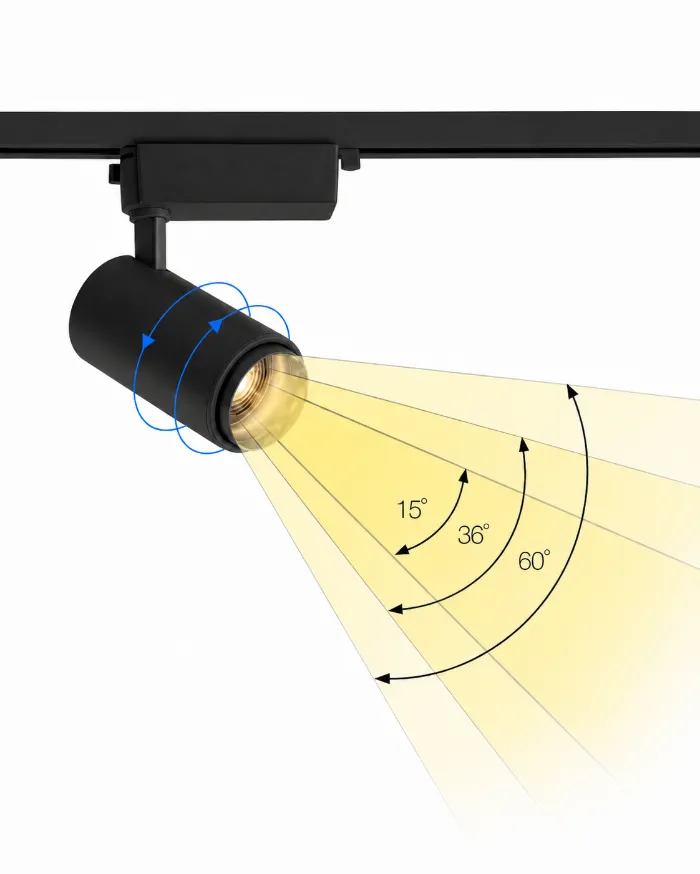
Optical design affects beam spread, center intensity, spill light, and glare control.
Choosing the Right Beam Angle for Track Spotlights
On-Site / Commercial Reality
Beam angle selection is one of the most common causes of rework in track lighting projects. A beam that is too narrow may only partially light products or displays, while a beam that is too wide can flatten the accent effect and spill into adjacent areas. Once the wrong beam angle is installed across a store, gallery, or restaurant, correction usually means fixture replacement, optical change, or a full re-aiming exercise.
Deep Dive & Engineering Solution
Beam angle should be selected according to three practical inputs:
Mounting height above the target plane
Size and reflectance of the object or display area
Required contrast between accent lighting and ambient lighting
In commercial lighting practice, beam distributions are often grouped as narrow, medium, and wide. These are practical specification categories rather than universal fixed standards.1
| Beam Type | Common Practical Use | Typical Project Logic |
|---|---|---|
| Narrow beam | Artwork, mannequins, small objects, feature tables, high ceilings | Concentrates light, supports strong accent, and helps maintain intensity over longer throw distances |
| Medium beam | Shelving, counters, retail walls, mixed commercial displays | Balances coverage, intensity, and aiming tolerance |
| Wide beam | Broad tables, circulation support, soft emphasis, wider display zones | Covers larger surfaces but may reduce focal contrast if overused |
As mounting height increases, the beam footprint expands and center intensity becomes more critical. The same spotlight can perform very differently at 2.8 m, 4 m, or 6 m, so designers assess the illuminated diameter, useful vertical illuminance, beam edge quality, and spill light at the target distance.
Retail display lighting often uses accent light to create visual priority over the ambient level. Depending on store type and display strategy, accent lighting may be designed at several times the ambient level rather than as a single fixed lux value.4 For galleries and museums, the process is more conservative because illuminance, spectrum, exposure time, glare, and conservation requirements must be controlled together.5
| Selection Factor | Narrow Beam | Medium Beam | Wide Beam | Project Impact |
|---|---|---|---|---|
| Ceiling height | Better for higher ceilings or longer throw | Good for standard commercial ceilings | Better for lower ceilings or broad targets | Correct matching reduces fixture replacement risk |
| Display size | Small objects, artwork, mannequins | Shelving, feature walls, counters | Large tables, broad surfaces | Better fit reduces on-site re-aiming |
| Accent contrast | High | Balanced | Low to moderate | Proper contrast improves visual hierarchy |
| Aiming sensitivity | High | Moderate | Lower | Wider beams are easier to commission but may weaken focus |
| Spill light control | Strong when aimed correctly | Balanced | More spill risk | Better spill control improves comfort and visual discipline |
Factory Note
In large hospitality and retail projects, beam angle is sometimes specified too broadly because teams want to avoid sharp hot spots. The result is often flat lighting with poor visual hierarchy. A better approach is to use controlled narrow or medium beams for focal elements and let ambient lighting handle background brightness.
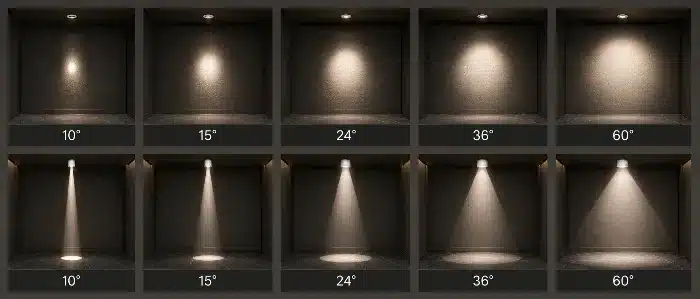
Different beam angles change the illuminated area, accent contrast, and aiming tolerance.
Common Applications of Track Lighting
On-Site / Commercial Reality
Commercial spaces rarely need uniform lighting everywhere. Products must stand out, artwork must be framed by light, tables must feel inviting, and brand zones must read clearly from circulation paths. Track spotlights can create this hierarchy without locking the project into a rigid ceiling plan, but the same strategy should not be copied directly from a gallery to a fashion store or from a cafe to a hotel lobby.
Deep Dive & Engineering Solution
LED track spotlights are widely used in the following commercial applications:
Retail stores
Used for mannequins, shelving, promotional walls, feature tables, and shopfront presentation. Here, contrast, color quality, vertical display visibility, and merchandise modeling are critical.6Galleries and museums
Used to highlight artwork, sculptures, and temporary exhibitions with precise aiming and controlled beam spread. In these spaces, mock-up testing, spectrum evaluation, glare control, and conservation requirements are especially important.5Hospitality spaces
Used in lobbies, restaurants, lounges, bars, and reception areas to reinforce atmosphere, focal points, and material texture.Commercial interiors
Used in showrooms, sales offices, brand experience centers, and circulation zones where flexibility and visual emphasis are needed.
The key difference is the target surface and viewing condition. Vertical displays often need controlled front light, table or object displays rely more on concentrated beam placement, and architectural features may require grazing, accenting, or layered composition with ambient lighting.
Factory Note
During hotel and retail commissioning, track spotlights are often adjusted several times after furniture, signage, merchandise, and decorative elements are fully in place. This is normal. The most reliable specifications are the ones that allow some aiming margin on site rather than depending on an exact theoretical position only.
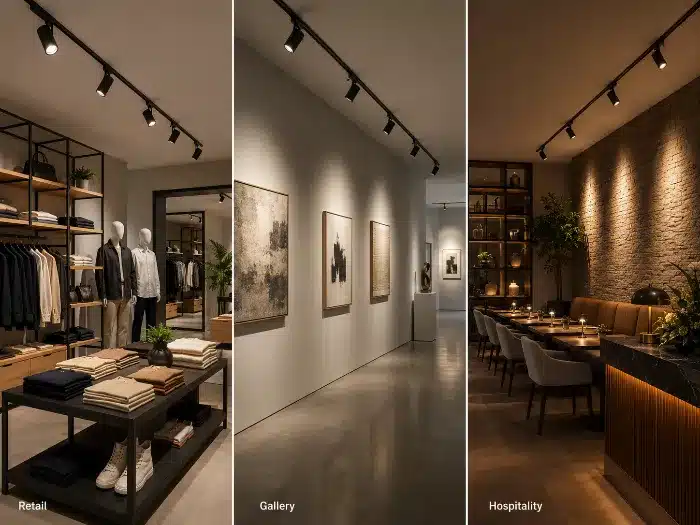
Track spotlights create flexible accent lighting for retail, gallery, and hospitality spaces.
Advantages of LED Track Spotlights in Commercial Lighting
On-Site / Commercial Reality
For B2B buyers, the value of track spotlights is not just appearance. In leased retail units, evolving product displays, and hospitality refurbishments, a flexible lighting platform can reduce repeated ceiling work and shorten update cycles, especially where maintenance access is difficult or business interruption has a direct cost.
Deep Dive & Engineering Solution
LED track spotlights offer several practical advantages in commercial lighting:
Flexible fixture positioning
Luminaires can be relocated without major rewiring, making them suitable for changing layouts.Accurate accent lighting
Controlled optics and adjustable aiming improve focal emphasis and support visual merchandising.Layered lighting integration
Track spotlights work effectively with downlights, linear lighting, and decorative luminaires to build contrast and hierarchy.Better adaptation to display changes
When products, artwork, furniture, or seasonal layouts move, the lighting can move with them.Efficient use of output
Directional lighting places light where it is needed, which is more effective than relying on uniform ambient lighting to create emphasis.Lower long-term operating cost when correctly specified
LED systems can reduce energy use and maintenance cost, but rated life, thermal conditions, dimming compatibility, optical stability, and actual operating hours should be verified from product data and project conditions.7
From a project standpoint, these advantages improve lighting quality and operational flexibility in spaces that require regular updates rather than static layouts.
Factory Note
From a manufacturing perspective, the best commercial track spotlight is not the one with the most aggressive specification sheet. It is the one that keeps optical consistency, mechanical aiming stability, electrical contact reliability, thermal performance, and color consistency across batches. In multi-store rollouts, batch-to-batch beam and color consistency are often more important than headline efficacy alone.
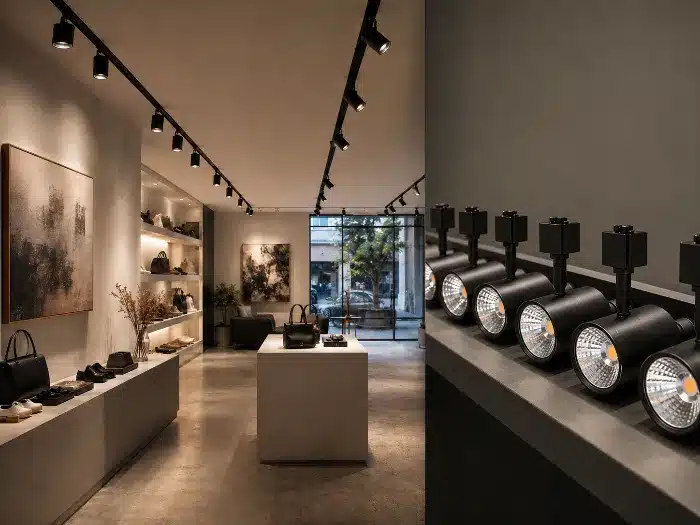
LED track spotlights support flexible accent lighting and long-term layout adaptation.
Track Lighting Layout Tips for Commercial Spaces
On-Site / Commercial Reality
A good fixture can still produce poor results if the layout ignores sightlines, target positions, ceiling geometry, or reflective surfaces. Common late-stage problems include uneven accent rhythm, shadow interference from shelving or signage, and glare caused by aiming directly into customer or guest view.
Deep Dive & Engineering Solution
Effective track lighting layout starts with the target, not the ceiling. The design process should evaluate:
What needs emphasis
From where it will be viewed
At what mounting height the fixtures will operate
How much ambient light already exists
Whether the target is horizontal, vertical, glossy, matte, flat, or textured
How often the layout is expected to change
Practical layout principles include:
Align tracks with display logic
In retail, tracks are often placed parallel to shelving runs, feature walls, or circulation routes. In galleries, they are aligned for flexible artwork aiming. In hospitality, they may define focal islands or layered zones.Match spacing to beam spread and throw distance
Fixture spacing should reflect the actual beam footprint at the target plane, not just the ceiling grid.Avoid direct glare angles
Spotlights should be aimed to highlight the target while limiting direct visual intrusion into guest or shopper sightlines.Check reflected glare
Glass shelves, polished counters, glossy artwork protection, metal finishes, and dark reflective surfaces can all create reflected glare even when the fixture itself appears well shielded.Plan for adjustability margin
Leave enough aiming range and track capacity for future changes. A layout that is too tight on paper becomes difficult to adapt later.Balance accent and ambient lighting
Track spotlights should support a layered lighting scheme, not replace all general lighting unless the concept specifically requires it.
For commercial projects, mock-up testing is highly recommended, especially when display reflectance, ceiling height, and target lux levels are critical. Photometric data should be checked against real mounting conditions before final rollout.89
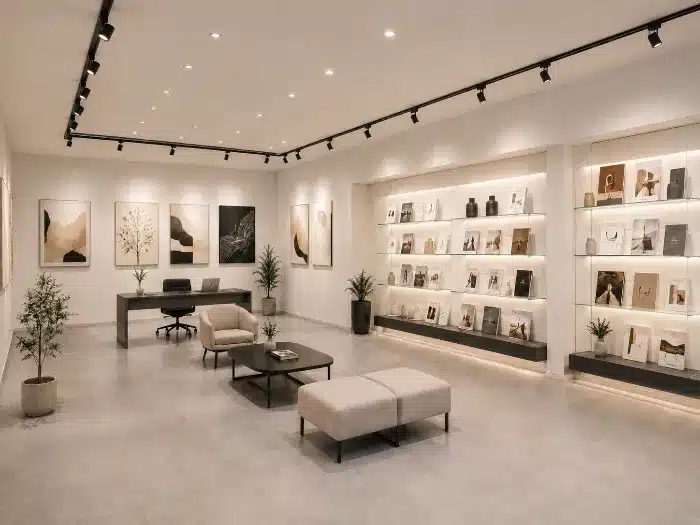
Track lighting layout should follow target positions, viewing direction, and beam spread.
How to Choose LED Track Spotlights for Commercial Projects?
| Project Requirement | Recommended Specification Focus |
|---|---|
| Retail shelf display | Medium beam, high CRI, stable color consistency, adjustable aiming |
| Mannequin or feature table | Narrow to medium beam, higher center intensity, controlled spill light |
| Gallery artwork | Precise beam control, low glare, suitable spectrum, mock-up testing |
| Hotel lobby or lounge | Warm CCT, low glare, stable dimming, refined material rendering |
| High ceiling application | Narrower beam, higher center beam intensity, verified photometric data |
| Frequently changing layout | Reliable track adapter, stable aiming friction, flexible beam options |
| Multi-store rollout | Batch color consistency, optical consistency, thermal reliability, clear QC control |
| Glossy display surfaces | Careful aiming, shielding accessories, reflected glare review |
FAQ
What beam angle is best for LED track spotlights?
There is no single best beam angle for all projects. Narrow beams are useful for artwork, mannequins, feature tables, and higher ceilings where stronger focus is required. Medium beams are more versatile for retail shelving, counters, and wall displays. Wide beams are better for broader targets, softer emphasis, or supplementary ambient support.
Are LED track spotlights suitable for retail stores?
Yes. LED track spotlights are widely used in retail stores because they support flexible accent lighting for shelves, mannequins, promotional displays, shopfront areas, and seasonal layout changes. For retail projects, the key is to match beam angle, color quality, glare control, and aiming flexibility to the merchandise and customer viewing path.
How far apart should track spotlights be placed?
Spacing depends on ceiling height, beam angle, target size, aiming angle, and required illuminance. Fixture spacing should be based on the actual beam footprint at the target plane rather than only the ceiling grid. For important commercial projects, a mock-up or photometric simulation is recommended before final rollout.
What is the difference between narrow beam and wide beam track spotlights?
A narrow beam concentrates light into a smaller area and creates stronger visual focus. A wide beam covers a larger surface but produces softer contrast and may create more spill light if overused. Medium beams usually provide a balanced option for many commercial interiors.
How can glare from LED track spotlights be reduced?
Glare can be reduced by correct aiming, suitable beam angle selection, proper fixture shielding, accessories such as louvers or snoots, and careful review of reflective surfaces. Viewing direction is also important because a spotlight that looks comfortable from one angle may create direct or reflected glare from another position.
Should LED track spotlights be selected only by wattage or lumens?
No. Wattage and lumen output are only part of the specification. Beam distribution, center beam intensity, color consistency, dimming behavior, thermal design, glare control, and mechanical aiming stability all affect the final lighting result in commercial projects.
Conclusion: Business Value
LED track spotlights remain one of the most effective tools for commercial accent lighting because they combine directional control, layout flexibility, and application-specific beam selection. When properly specified, they improve visual hierarchy, reduce unnecessary spill light, and adapt more easily to future display changes.
From a business perspective, correct track spotlight selection supports three practical outcomes: better delivered lighting performance, lower maintenance effort during layout changes, and reduced lifetime system cost by avoiding repeated ceiling modification or fixture replacement.
B2B Engineering Recommendation
For commercial track spotlight projects, request beam angle samples, photometric files, mounting height details, target lux requirements, dimming requirements, and project layout information before final specification. Buyers can review TECO’s lighting fixtures as a starting point for compatible fixture options, then contact the TECO engineering team with drawings and project requirements for beam selection, optical comparison, dimming verification, and project-based sample testing before mass production.
Footnotes
Narrow, medium, and wide beam are practical commercial lighting selection terms rather than fixed universal ranges. Actual beam category naming varies by manufacturer and should be verified with product photometric data and samples. Source: PNNL / DOE Smithsonian report. ↩ ↩
LED replacement lamps and directional luminaires should not be treated as one-for-one equivalents based only on wattage or lumens because beam characteristics, intensity, color, and distribution can differ significantly. Source: PNNL / DOE GATEWAY, Demonstration of LED Retrofit Lamps at the Smithsonian American Art Museum. ↩
Beam angle is defined by the Illuminating Engineering Society as the angle between the two directions where luminous intensity falls to 50% of maximum intensity. Source: IES, “Beam Angle”. ↩
Retail accent lighting is often designed at several times the ambient level rather than one fixed lux value. The Waypoint Lighting quick reference table lists retail ambient / perimeter levels and notes that display accent lighting can be 3–10 times the ambient level. Source: Waypoint Lighting, IES Recommended Light Levels Quick Reference Guide. ↩
Museum and gallery lighting require controlled beam spread, precise aiming, glare control, illuminance limits, spectrum review, exposure management, and mock-up testing. Source: IES Recommended Practice: Lighting Museums. ↩ ↩
Retail lighting quality, merchandise visibility, display contrast, accent lighting, glare, and vertical illuminance are covered in ANSI/IES RP-2-20, Recommended Practice: Lighting Retail Spaces. Source: IES RP-2-20. ↩
LED systems can reduce energy use and maintenance cost, but rated life and savings depend on product design, thermal conditions, test method, dimming compatibility, and operating environment. Sources: DOE, “LED Lighting”; PNNL / DOE Smithsonian report. ↩
Beam quality, color quality, optical performance, and visual results should be verified with samples, mock-ups, or project testing when visual quality is critical. Source: PNNL / DOE GATEWAY Smithsonian report. ↩
DOE / PNNL GATEWAY museum reports support verification under real project conditions, especially in museums, galleries, and high-visual-quality commercial interiors. Sources: DOE GATEWAY Indoor Project Archives; PNNL Smithsonian report. ↩