GU10 vs Integrated LED Downlights in 2026: Which Is Better for Your Project?
Choosing between a replaceable GU10 lamp and an integrated LED downlight is no longer a simple “old technology versus new technology” decision. Both formats use LED technology, and both can deliver efficient, attractive lighting. The real difference is where the light engine, driver, optics and thermal system are located—and what happens when the project needs a different beam, color temperature or replacement five years later.
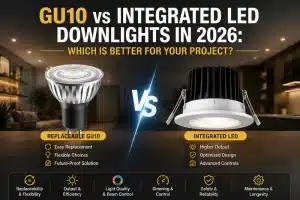
A GU10 downlight separates the fixture from the lamp. The ceiling fitting holds a standardized GU10 socket, and the user can remove and replace the bulb. An integrated LED downlight combines the LED module, driver, heat sink and optical system into one luminaire. When its light source or driver fails, the complete module—or sometimes the entire fitting—usually needs replacement.
Neither format is automatically better. GU10 generally wins on replaceability, product choice and future flexibility. Integrated LED generally wins on compact dimensions, thermal design and maximum output from a small aperture. The correct choice depends on the application, maintenance strategy and expected life of the building.
إجابة سريعة
Choose a GU10 downlight when the project values:
- A replaceable light source
- Easy changes to CCT, CRI, beam angle or output
- Access to specialist lamps such as CRI98 GU10, dim-to-warm or narrow-beam models
- Simple local maintenance without replacing the ceiling fitting
- Reduced dependence on one luminaire model remaining available
Choose an integrated LED downlight when the project values:
- Higher lumen output from a compact aperture
- A complete optical and thermal system designed as one unit
- Very shallow ceiling depth
- Wide general-lighting distributions
- Project-level controls such as DALI, 0–10 V or remote drivers
For long-life residential, hotel and retail projects, do not compare purchase price alone. Compare the complete system: fitting, lamp or module, driver, dimming controls, installation labor, replacement availability and the cost of restoring a consistent appearance after a product is discontinued.
GU10 and Integrated LED: What Is the Structural Difference?
In a GU10 system, the ceiling fitting mainly provides mechanical support, electrical connection and—in suitable products—fire, acoustic or ingress protection. The GU10 lamp contains its own LED package, driver, optics and heat-management structure. Standard GU10 lamps are normally around 50 mm in diameter, although their length and front profile vary. Our guide to GU10 dimensions and fixture compatibility explains why checking depth and bezel clearance matters.
In an integrated downlight, the LED board, heat sink, lens or reflector and driver are selected as a matched system. This gives the manufacturer more freedom. The heat sink can be larger than the visible aperture, the driver can sit outside the light engine, and the optical system does not need to fit inside a replaceable 50 mm lamp envelope.
That design freedom can improve output and efficiency, but it creates a dependency: the replacement normally needs to match the original cutout, depth, connector, driver, appearance, color and photometric distribution.
Side-by-Side Comparison
| Decision factor | Replaceable GU10 downlight | Integrated LED downlight |
|---|---|---|
| Light-source replacement | Replace the GU10 lamp | Usually replace the module or fitting |
| Initial product choice | Very broad | Limited to the selected luminaire family |
| Output potential | Limited by lamp size and heat | Often higher for the same visible aperture |
| Beam flexibility | Change the lamp or select adjustable optics | Fixed by the luminaire unless optics are interchangeable |
| High-CRI options | Easy to specify specialist lamps | Available, but must be selected with the complete fitting |
| التعتيم | Depends on lamp, dimmer and circuit load | Depends on the supplied driver and control protocol |
| Ceiling depth | Lamp and holder require space | Ultra-shallow designs are available |
| الصيانة | Familiar, fast lamp replacement | May require electrician or matching replacement module |
| Future availability | Standardized socket reduces lock-in | Exact model may become unavailable |
| IP/fire rating | Determined by the complete fitting, not the bulb alone | Usually tested as a complete luminaire |
1. Replaceability and Product Obsolescence
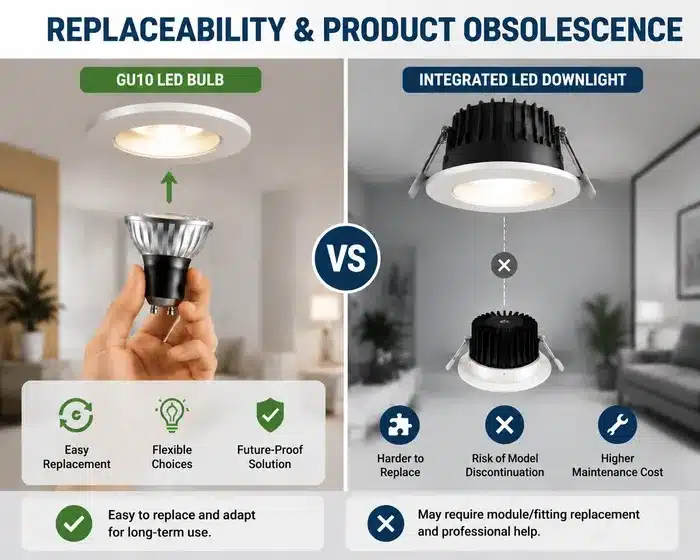
Replaceability is the clearest advantage of GU10. If one lamp fails, the maintenance team can usually isolate the circuit, remove the lamp and install a compatible replacement without disturbing the ceiling. The fitting can remain in service through several generations of LED lamps.
That does not mean every GU10 is visually interchangeable. A replacement with a different CCT, beam angle, lumen output, lens texture or color tolerance may look inconsistent beside older lamps. Professional projects should record the model, CCT, CRI, beam, dimming type and color-tolerance data, and retain a small quantity of spare lamps from the original production batch.
With integrated downlights, replacement can be more complicated. Even if the electrical connector is simple, the new module must fit the existing cutout and mounting depth. Its bezel size, finish, lumen output and beam distribution should also match adjacent units. If the original model is discontinued, replacing one failed downlight may create a visible mismatch—or force a larger group replacement.
Integrated products are not necessarily unreliable. The issue is system continuity. A claimed 50,000-hour LED life does not guarantee that the driver, connector and exact model will remain available for the same period.
2. Output, Efficacy and Thermal Management
Integrated LED downlights can dedicate more physical space to the heat sink and driver. This makes it easier to produce high lumen packages while controlling LED junction temperature. They are therefore strong candidates for high ceilings, general lighting and applications that require substantial output from a small number of luminaires.
A GU10 lamp must place the LEDs, optics, driver and thermal path inside a compact body. Higher wattage is not automatically better: if the installed fitting traps heat, the lamp may reduce output, shift color or experience shorter driver life. The practical limit depends on the lamp construction, airflow and surrounding fixture—not only the wattage printed on the box.
GU10 remains highly effective for accent lighting because total lumens are only part of the result. A controlled 10° or 24° beam can deliver more illuminance to a small product display than a higher-lumen wide-beam downlight. Read our guide to GU10 lumens, beam angle and brightness before comparing output figures.
For a fair comparison, request:
- Delivered lumens at operating temperature
- Beam angle and field angle
- Peak intensity in candela
- Lux at the intended mounting distance
- Lumen maintenance data
- Maximum ambient temperature
- Photometric files such as IES or LDT where available
3. Light Quality: CRI, R9 and Color Consistency
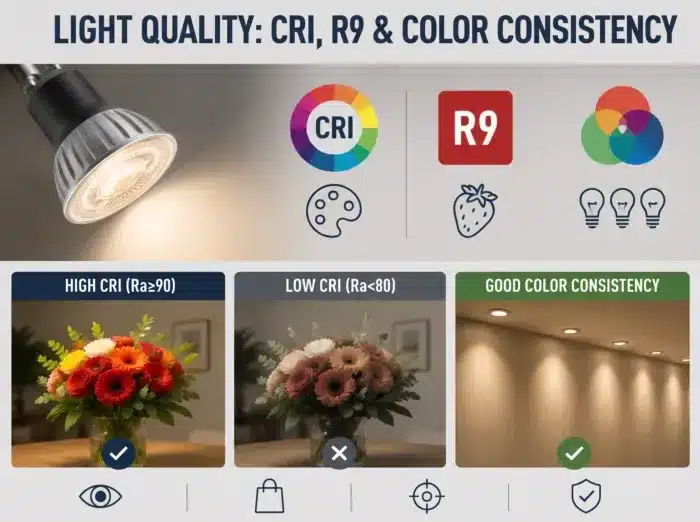
Integrated LED does not automatically provide better color, and a replaceable lamp does not automatically provide worse color. Both formats can use high-quality LEDs. The difference is how easily the specification can be changed.
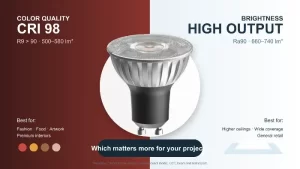
GU10 gives designers access to specialist combinations: high CRI, strong R9, different CCTs, narrow beams, dim-to-warm and high-output variants. If a fashion retailer later changes its materials or a restaurant wants warmer evening light, changing the lamp may be sufficient.
Integrated luminaires can provide excellent color consistency when the LED board, reflector and driver are engineered together. However, the required color-quality option must normally be ordered with the fitting. Retrofitting a different spectrum later may mean replacing the module or complete luminaire.
Do not approve either system using CRI alone. Review R9 for saturated red, color consistency, CCT, Duv and—where color is business-critical—TM-30 data. For retail applications, see our high-CRI GU10 project guide.
4. Beam Angle and Aiming Flexibility
Most GU10 families offer several beam angles. A project can use a narrow beam for artwork, a medium beam for tables and a wider beam for circulation while retaining the same visible fitting. Some lamps provide adjustable optics; for example, a zoomable GU10 can change the illuminated area without replacing the ceiling hardware.
Integrated downlights often deliver a cleaner, broader general-lighting distribution because the reflector and light engine are designed together. Professional product families may also offer interchangeable reflectors, but this feature must be confirmed before purchase.
Check whether the application needs a fixed downlight or an adjustable gimbal. Beam angle describes light spread, while aiming determines where that beam lands. A good beam pointed at the wrong location still produces poor lighting.
5. Dimming and Control Compatibility
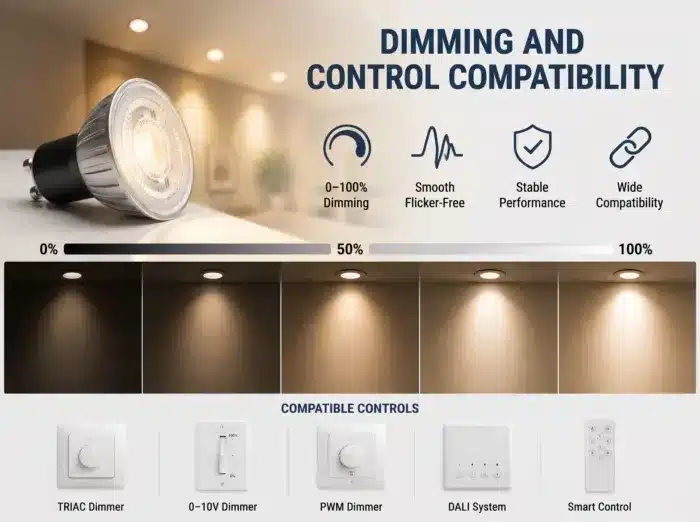
GU10 lamps usually operate directly from mains voltage and commonly use phase-cut/TRIAC dimming. Performance depends on three components working together: the lamp driver, the dimmer and the total circuit load. A lamp marked “dimmable” may still show flicker, buzzing, pop-on, dropout or limited low-end range with an unsuitable dimmer.
Integrated downlights can also use phase-cut drivers, but they have more room for remote or dedicated drivers. Commercial versions may support 0–10 V, DALI, DMX or wireless control. This makes integrated luminaires attractive for larger building-control systems.
However, a sophisticated control label does not replace testing. Verify:
- Control protocol and wiring topology
- Minimum and maximum driver load
- Number of luminaires per channel
- Low-end dimming level
- Flicker performance at full and reduced output
- Standby behavior and switch-off leakage
- Compatibility with emergency and automation systems
If the project uses phase-cut controls, review what 0–100% dimmable GU10 really means and test the exact lamp–dimmer combination before bulk ordering.
6. Installation Depth, Fire Rating and Wet Locations
Integrated downlights can be extremely shallow, making them useful where ducts, concrete or limited ceiling voids restrict depth. A GU10 fitting must accommodate the lamp, holder, wiring and safe clearance, so the complete assembly is often deeper.
Safety and environmental ratings apply to the installed system. An IP65 bezel does not make every lamp or installation suitable for every wet location. Similarly, fire rating is normally a characteristic of the complete downlight construction and its installation method—not a claim created by inserting a particular GU10 bulb.
Before specifying either format, confirm:
- Ceiling cutout and available depth
- Required fire rating and test standard
- IP rating for the installation zone
- Insulation-clearance requirements
- Ventilation and maximum ambient temperature
- Local electrical and building regulations
Do not modify an integrated fitting or convert its wiring to accept a GU10 lamp unless the luminaire manufacturer provides an approved retrofit method. Unauthorized modification can create electrical, thermal, certification and insurance risks.
7. Maintenance and Total Cost of Ownership
The cheapest unit price does not necessarily produce the lowest project cost. A useful comparison covers the expected operating period.
GU10 cost model
Include:
- Downlight fitting
- GU10 lamp
- Compatible dimmer or control
- Replacement lamps
- Labor for accessible lamp changes
- Spare stock for visual consistency
Integrated LED cost model
Include:
- Complete luminaire and driver
- Control gear
- Replacement modules or fittings
- Electrician access and ceiling work
- Recommissioning of control systems
- Potential group replacement if the original model is unavailable
For a small residence with accessible ceilings, replacing an integrated downlight may be manageable. For a hotel with hundreds of rooms, a discontinued module can become a procurement and visual-consistency problem. Conversely, an integrated system with a documented replaceable driver and guaranteed module availability may deliver an excellent lifecycle result.
Ask the supplier what is replaceable, how long replacements will remain available and whether the warranty covers only the component or also removal and reinstallation labor.
Application Guide
Residential renovations
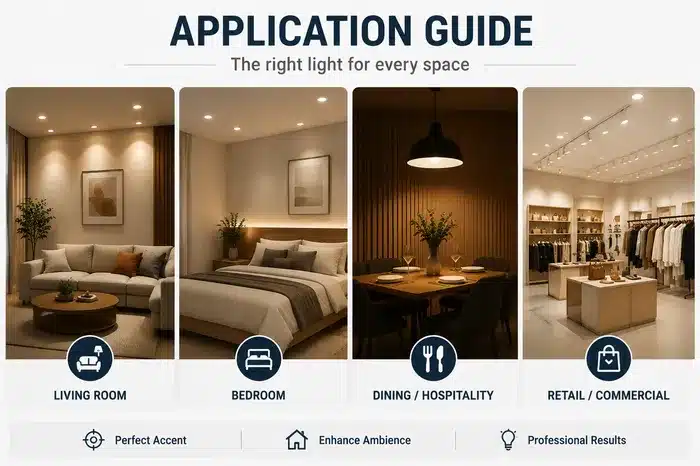
GU10 is a strong choice when homeowners want to change color temperature, beam or smart functions later. Integrated downlights are useful in shallow ceilings, bathrooms and areas needing a tested sealed fitting. Many homes benefit from a mixed approach rather than forcing one format into every room.
Hotels and restaurants
GU10 supports fast room-level replacement and specialist dim-to-warm or high-CRI options. Integrated LED may be preferred for lobby general lighting, high-output areas and centralized control. Standardize a small number of approved lamp and fitting combinations to reduce maintenance complexity.
Retail and galleries
GU10 is valuable when merchandise, exhibitions or layouts change frequently. Replaceable beam and color options give the visual-merchandising team flexibility. Integrated track or recessed systems may be better where the project needs higher intensity, precision accessories or advanced controls.
Offices and large commercial spaces
Integrated luminaires are usually more suitable for broad, efficient general lighting and building-wide controls. GU10 can still support reception desks, artwork, meeting-room accents and small focused zones.
High ceilings
Do not select by lamp format alone. Calculate required target lux and compare candela at the installed distance. Integrated products often offer higher intensity, but a narrow-beam professional GU10 may be sufficient for selected accent applications.
A Better Decision Framework
Answer these questions before requesting quotations:
- Is the lighting primarily ambient, task or accent lighting?
- What lux level is required on the target surface?
- Will the layout, merchandise or artwork change?
- Must the light source be replaceable without changing the fitting?
- What ceiling depth, cutout, IP and fire requirements apply?
- Which CRI, R9, CCT and color-tolerance values are required?
- Is the beam fixed, adjustable or zoomable?
- Which dimming or control system will be used?
- Who will maintain the installation, and how difficult is access?
- What replacement components will be available in five or ten years?
If the answers emphasize flexibility, local replacement and specialist light quality, GU10 is likely the better platform. If they emphasize compact construction, high output and system-level control, integrated LED is likely stronger.
Sample Testing Checklist for Project Buyers
Never approve a large order from a catalog comparison alone. Install samples in the real or representative fitting and check:
- Physical fit, depth and bezel clearance
- Startup consistency across multiple units
- Beam shape, cutoff and spill light
- Target lux at the actual mounting height
- Color appearance on skin, food, textiles, wood and painted surfaces
- Color consistency between samples
- Dimming from maximum to minimum and back again
- Flicker, buzzing, pop-on and dropout
- Surface temperature after extended operation
- Removal and replacement procedure
- Appearance of a replacement sample beside an aged unit
Use the same supply voltage, dimmer, circuit load and enclosure planned for the project. Our LED quality inspection checklist provides additional checks for bulk procurement.
Common Purchasing Mistakes
Comparing only watts and lumens
Watts describe input power, and lumens describe total light output. Neither tells you whether the target receives enough light or whether the beam is appropriate.
Treating “replaceable” as “identical forever”
GU10 sockets are standardized, but lamp appearance and performance vary. Keep full specifications and project spares.
Assuming a long LED-life claim covers the complete luminaire
LED lumen maintenance, driver survival and product availability are different issues. Ask for the evidence and warranty terms behind each claim.
Ignoring the dimmer until installation
Dimming compatibility must be confirmed before the bulk order, not after flicker appears on site.
Applying the bulb’s rating to the complete fitting
IP, fire and insulation requirements must be evaluated for the complete installed assembly.
Final Verdict: Which One Should You Choose?
The strongest reason to choose GU10 in 2026 is not nostalgia. It is modularity. A standardized replaceable lamp lets the project change output, spectrum, beam and dimming characteristics while retaining the fitting. This is valuable where visual requirements change and maintenance teams need a straightforward replacement process.
The strongest reason to choose integrated LED is engineering freedom. A purpose-designed luminaire can use a larger heat sink, optimized reflector and dedicated driver to achieve higher output, shallow dimensions and advanced control from a compact product.
For many projects, the best specification is hybrid:
- Integrated LED for broad general lighting, shallow ceilings or centralized controls
- Replaceable GU10 for accent lighting, high-CRI displays, hospitality atmosphere and areas where future flexibility matters
Judge the result at project level. A well-designed GU10 installation is better than a poorly selected integrated system, and a well-supported integrated luminaire is better than a low-quality replaceable lamp. The correct product is the one that meets the photometric target today and can still be maintained consistently tomorrow.
الأسئلة المتكررة
Are integrated LED downlights better than GU10?
Not universally. Integrated downlights often provide higher output, shallower construction and more control options. GU10 provides easier replacement and greater freedom to change beam, color and light quality.
What happens when an integrated LED downlight fails?
Depending on its construction, the driver, LED module or complete fitting must be replaced. Confirm component replaceability and future availability before purchase.
Can GU10 bulbs be used in fire-rated downlights?
They can be used in compatible fire-rated GU10 fittings, but the complete installed downlight—not the bulb alone—must meet the required rating and installation conditions.
Which option is better for dimming?
Both can dim well when properly engineered. GU10 phase-cut performance depends on lamp and dimmer compatibility. Integrated downlights may offer dedicated phase-cut, 0–10 V or DALI drivers. Test the exact system.
Which option produces more light?
Integrated products usually have greater high-output potential because they have more room for thermal management. However, target brightness also depends on beam angle and candela, so a narrow-beam GU10 can outperform a wider high-lumen product on a small target.
Is GU10 still relevant in 2026?
Yes. GU10 remains relevant where replaceability, beam choice, high-CRI options, dim-to-warm performance and simple maintenance are priorities. It is not the ideal format for every general-lighting application.
Comparing GU10 With an Integrated LED Solution?
Send TECO your ceiling detail, mounting height, target lux, required beam angle, CCT, CRI, dimming system and project quantity. We can recommend a GU10 configuration and provide samples, photometric data and compatibility information for project evaluation.
Primary button: Request GU10 Samples
Secondary button: Compare GU10 Models
Text link: Download Technical Data