High-Performance Residential LED Lighting: Design Principles, Specifications, and Real-World Decisions
Residential lighting often gets treated as an afterthought—pick a bulb, screw it in, hope it looks fine. But the cost of mediocre lighting is not subtle. Poor visibility, eye fatigue, color distortion, visual clutter, inconsistent mood across spaces. And for modern homes with open layouts, tall ceilings, and reflective surfaces, the stakes are higher.
LED technology solved some of the old inefficiencies, but it also introduced complexity: driver compatibility, beam distribution, CCT uniformity, spectral accuracy, dimming behavior, thermal loads. A homeowner may not care, but anyone designing, supplying, or specifying lighting for residential projects needs to make choices that are consistent, durable, and technically defensible.
This article outlines measurable targets, practical design workflows, and perspective based on what actually works—not what looks good in a brochure.
1. Why LED Matters in Residential Lighting
LED isn’t a trend. It’s an efficiency upgrade, a control upgrade, and a color-quality upgrade.
Real numbers:
- 90–120 lm/W for common residential lamps
- 25,000–50,000 hours rated life (if heat is managed)
- 70–95% less heat than halogen
- 85–95 CRI is achievable with minimal efficacy penalty
- 15–20% energy reduction achievable purely from dimming
These are not revolutionary. But together, they reshape how lighting is installed, maintained, and lived with.
1.1 Efficiency, with caveats
LED is efficient. Until it isn’t.
Poor drivers, low power factor, high in-rush, thermal choking in enclosed fixtures.
If you want LEDs to actually save on bills:
- Target ≥100 lm/W for general residential lamps
- Power factor ≥0.9 for high-use zones
- Avoid enclosed fixtures unless specifically rated
And remember: 8 recessed cans running 4 hours/day at 60W vs 10W is not a small delta.
Annual energy difference can exceed $100–150/year per room in high-cost regions.
1.2 Visual comfort is measurable
This is where LED really changes design.
Not because it’s “soft” or “natural”.
But because it allows:
- Controlled spectra
- Accurate color (≥90 CRI; Rf ≥85)
- Low-flicker dimming
- Beam shaping, not just reflector shaping
Bad lighting is easy to spot.
It’s just rarely measured.
1.3 Lifespan is tied to heat
Survival rates are steep curves.
Many LED failures are driver failures, not emitter failures.
A rule of thumb:
- Open fixtures: fine
- Semi-enclosed: use 15–30W equivalents
- Enclosed: use low-heat, low-lumen lamps
If you install 15W PAR lamps in 3” cans with no airflow, don’t blame LED when they fail at 6,000 hours.
2. What Residential Lighting Should Achieve (Functionally)
Residential spaces are not commercial spaces. But they increasingly serve similar functions—work, interaction, presentation, digital presence.
Lighting should solve four problems simultaneously:
- Visibility (tasks, safety, navigation)
- دقة الألوان (skin tone, materials, food, art)
- Spatial modeling (layering, depth, contrast)
- Comfort (glare, flicker, CCT dynamics)
Most homes fail 2–4.
Why?
Builders install uniform wide-beam downlights, equal spacing, equal power, equal CCT, and zero control.
The result:
Bright but flat.
Or dim but inconsistent.
Lighting should treat rooms as visual environments, not boxes.
3. A Practical Workflow for Residential Lighting Design
A lighting plan is not picking bulbs.
It’s solving rooms.
Step 1: Define activity zones

Not “living room.”
Zones.
أمثلة:
- TV zone
- Reading zone
- Dining zone
- Circulation zone
Each needs different light.
Step 2: Set target illuminance
Typical residential targets:
| Space/Task | Target (lux) |
|---|---|
| Living ambient | 150–300 |
| قراءة | 300–500 |
| Kitchen task | 500–800 |
| Dining | 100–200 |
| Bathroom vanity | 200–400 vertical |
| Bedroom ambient | 50–150 |
| Office desk | 500–800 |
These are not strict.
They’re direction.
Step 3: Assign fixture types

أمثلة:
- 4” BR retrofit for ambient
- PAR20/30 for accent/task
- Linear under-cabinet for shadow control
- A19 warm-dim for comfort
A room needs more than one.
Step 4: Define beam distributions
Simple rule:
- Ambient: wide beam
- Task: medium beam
- Accent: narrow beam
Numbers:
- Wide: 90–120°
- Medium: 40–60°
- Narrow: 10–25°
Ceiling height matters.
3m ceiling with 120° beams = floor wash, no modeling.
Step 5: Control strategy
- Dimmer per zone
- Scene presets
- Smart scheduling
- Avoid mixing dimmer technologies
Smart bulbs are a last resort.
Not a system.
4. Choosing LED Lamp Formats: What Works Best
Residential lighting rarely uses fixtures with architectural optics. Lamps must compensate.
4.1 A-lamps: comfort, not performance
Best use:
- غرف النوم
- Table lamps
- Lounge seating
Targets:
- 2700K warm-dim
- CRI ≥ 90
- 800–1100 lm
Avoid 5000K A-lamps.
They make wood and skin look dead.
4.2 BR lamps: ambient fill, with compromise

Best use:
- Living rooms with cans
- Hallways
- Low ceilings
Targets:
- Beam 100–120°
- 800–1200 lm
- 2700–3000 كلفن
Downside:
Flat light.
Needs accent lighting to balance.
4.3 PAR lamps: the underrated hero
Best use:
- Countertops
- Art walls
- Dining focal points
- High ceilings
Targets:
- Beam 15–40°
- 600–1200 lm
- 3000–3500K for task
Opinion:
More homes should use PAR beams.
They add geometry.
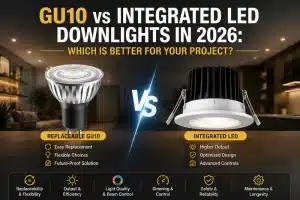
4.4 MR16 / GU10: precise, compact
Best use:
- Tracks
- Niche display
- إضاءة مركزة
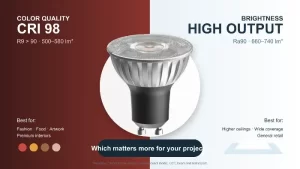
Targets:
- Beam 10–36°
- CRI ≥ 95 recommended
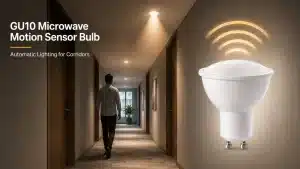
GU10 warm-dim makes great evening light.
MR16 + 12V drivers: can be messy.
4.5 Globes (G25): face-based lighting
Best use:
- Bathroom vanity
Goals:
- Vertical illuminance
- Shadow reduction
Avoid top-only ceiling lighting at mirrors.
It adds 10 years to your face.
5. Color Temperature and Spectrum: Real Strategies

Warm looks good.
Cool feels clean.
Neutral balances both.
But that’s not the full story.
5.1 Typical residential targets
| Space | درجة حرارة اللون المترابط |
|---|---|
| Living | 2700–3000 كلفن |
| المطبخ | 3000–4000K |
| Dining | 2700 كلفن |
| غرفة النوم | 2200–2700K |
| الحمام | 3000–3500K |
| المكتب | 3500–4000K |
5.2 What is “too cool”?
Opinion:
- 4000K in bedrooms is a mistake.
- 5000K anywhere is rarely justified.
Unless you’re growing plants or doing surgery.
5.3 CRI and TM-30 matter more than CCT
Practical thresholds:
- CRI ≥ 90
- Rf ≥ 85
- Rg 95–105
These numbers affect:
- Skin
- Wood
- Meat
- Art
- Clothing
Residential spaces often display all of these.
5.4 Warm-dim is underrated
Warm-dim solves a simple problem:
- Daytime needs clarity
- Nighttime needs comfort
Going from 3000K → 2200K as you dim feels natural.
Not “smart”.
Just sensible.
6. Beam Angles, Ceiling Heights, and Application Examples
Lighting cannot be separated from geometry.
Case 1: 2.4 m ceiling
BR30, 120° beams
Result: Even wash, limited contrast
Add:
- Two PAR20s with 25° beams on art
- One floor lamp at 2700K warm-dim
Instant depth.
Case 2: 3.0 m ceiling
BR floods underperform
Too much spill
Use:
- PAR30 narrow beams
- Higher candela
- 3000–3500K
Results:
- Surfaces light up
- Faces readable
- No cave effect
Case 3: Long corridor
Even spacing, wide beams = tunnel
Better:
- Alternating beams
- 40–60° beams with scallops
- Low-level floor lighting
Not necessarily practical.
But better.
7. Control Systems That Actually Work
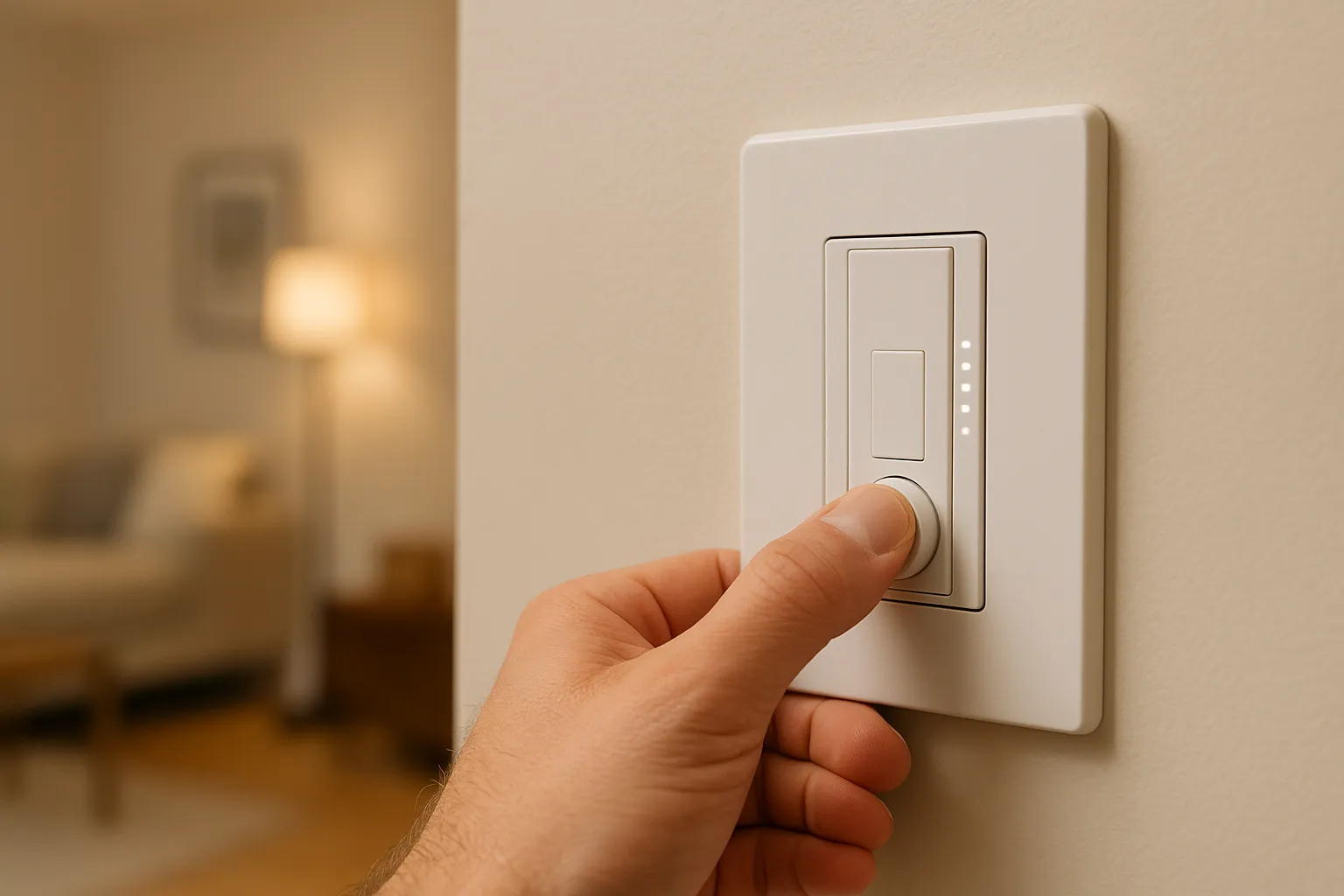
Smart lamps are fine for rentals.
Not for homes with 30+ fixtures.
Better approach:
- Smart dimmers controlling dumb lamps
- Scene presets
- Adaptive scheduling
And avoid mixing:
- TRIAC
- ELV
- 0–10V
- DALI
It creates compatibility problems that look like “flicker”, but are actually “electrical negotiation failures”.
8. Common Residential Lighting Mistakes
Too much uniform light
Kills depth.
Makes rooms feel larger but emptier.
Too many high-beam fixtures
Glare.
Hotspots.
Annoyance.
Overreliance on overhead lighting
Humans communicate at face level.
Light should, too.
Random CCT mixing
2700K next to 4000K?
رقم.
Ignoring vertical illumination
Vertical surfaces define space.
Horizontal lux is overrated.
9. A Practical Residential Specification Cheat Sheet
Minimum targets
- CRI ≥ 90
- Rf ≥ 85
- PF ≥ 0.9
- Flicker <5% (IEEE-1789 recommended)
- 100–120 lm/W for general use
Beam angles
- Ambient: 90–120°
- Task: 40–60°
- Accent: 10–25°
CCT by category
- Social: 2700K
- Work: 3500–4000K
- Evening: 2200–2700K
Warranty
- 3 years minimum
- 5 years preferred
- Not negotiable for enclosed fixtures
10. A Case Study: Lighting a 90 m² Apartment
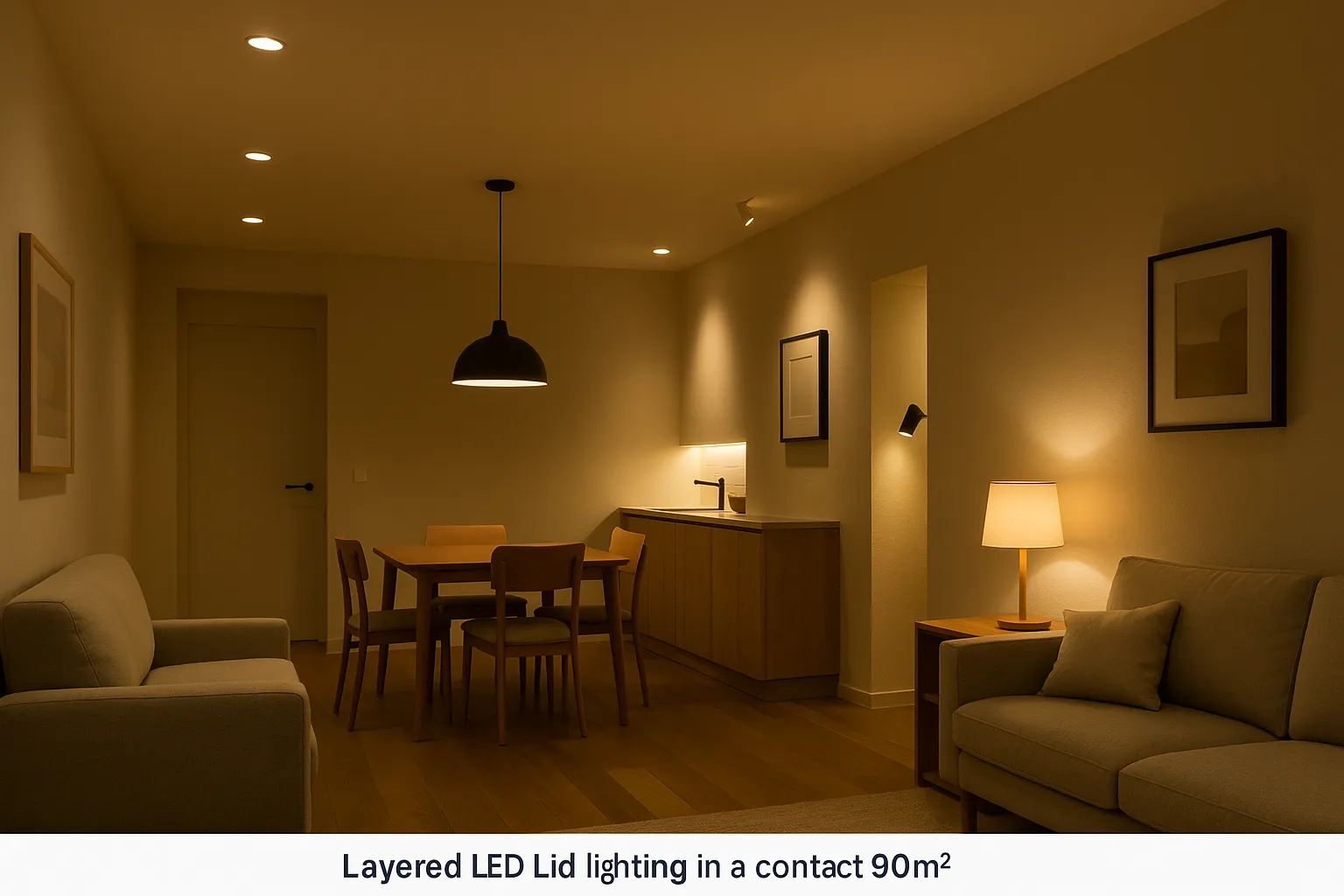
Spaces:
- Living + dining
- المطبخ
- 2 bedrooms
- 2 bathrooms
- Office nook
Equipment:
- BR30 ambient: 14 pcs
- PAR20 accent: 6 pcs
- A19 warm-dim: 8 pcs
- Under-cabinet LED linear: 5m
Metrics:
- Average ambient: 200–250 lux
- Accent: 400–600 lux
- Vanity vertical: 250 lux
Cost:
- Retrofit lamps: $500–$800
- Controls: $200–$500
- Total: $700–$1,300
Outcome:
- Cleaner color
- Deeper spaces
- Lower fatigue
- 30–40% lower energy use
Not dramatic.
But noticeable.
11. Final Perspective

Residential lighting is not complicated.
But it is misunderstood.
Most people install too many wide beams.
Not enough directional beams.
Too cool.
Too overhead.
Zero control.
LED gives tools to fix this:
- High CRI
- Controlled beams
- Intelligent dimming
- Low heat
- Efficient lumens
But tools only matter if someone uses them well.
The best residential lighting is not bright.
It’s layered, controlled, color-accurate, and spatially intentional.
Good lighting is quiet.
But unmistakable.
We supply LED solutions with:
High CRI (90–95)
Warm-dim technology
Controlled beam optics (10°–120°)
Low-flicker dimming performance
GU10, PAR20/30, BR, A19 formats
Suitable for:
Residential fit-outs
Hospitality upgrades
Builder/developer packages
Distributor portfolios
If you need technical datasheets, samples, or pricing, feel free to request them.
Send us your product list or target specifications—
We’ll reply with compatible options and lead times