Projecteurs LED vs Halogène : Lequel est meilleur ?
Dernière mise à jour le 3 mars 2026
Les spots halogènes étaient autrefois la norme pour l'éclairage d'accentuation, les présentoirs commerciaux et les downlights résidentiels. Aujourd'hui, les spots LED dominent le marché.
Mais les ampoules halogènes sont-elles réellement moins bonnes — ou les LED sont-elles simplement plus efficaces ?
Ce guide propose une comparaison neutre et étayée par des données entre les spots LED et halogènes, couvrant :
- Efficacité énergétique
- Durée de vie
- Qualité de la lumière
- Chaleur et sécurité
- Impact environnemental
- Coût total sur 5 ans
Toutes les affirmations sont étayées par des sources reconnues de l'industrie.
Comparaison rapide : LED vs Halogène
| Fonctionnalité | Spot LED | Ampoule halogène |
|---|---|---|
| Consommation d'énergie (équivalent GU10 typique) | 6–8W | 50–60W |
| Efficacité lumineuse | 90–150 lm/W | 15–25 lm/W |
| Durée de vie | 25 000 à 50 000 heures | 1 000–2 000 heures |
| Débit thermique | Faible | Très élevé |
| Gradation | Nécessite un pilote compatible | Excellent gradation native |
| Coût d'exploitation sur 5 ans | Inférieur | Significativement plus élevé |
Références des données :
Ministère de l'Énergie des États-Unis (DOE) – Bases de l'éclairage LED
https://www.energy.gov/eere/ssl/led-lighting
Comparaison d'éclairage Energy Star
https://www.energystar.gov/products/lighting_fans/light_bulbs
1. Efficacité énergétique : Quelle puissance chacun utilise-t-il ?
Les ampoules halogènes génèrent de la lumière en chauffant un filament de tungstène à des températures élevées (environ 2 500–3 000 °C). La majeure partie de l'énergie est convertie en chaleur plutôt qu'en lumière visible.
Les LED utilisent l'électroluminescence — les électrons se recombinent dans un matériau semi-conducteur pour émettre directement de la lumière, avec beaucoup moins de gaspillage thermique.
Selon le département américain de l'énergie :
- L'éclairage LED utilise au moins 75% moins d'énergie que l'éclairage à incandescence et halogène.
- Les LED durent jusqu'à 25 fois plus longtemps que les ampoules traditionnelles.
Source :
DOE – Aperçu de l'éclairage LED
https://www.energy.gov/eere/ssl/led-lighting
En termes pratiques :
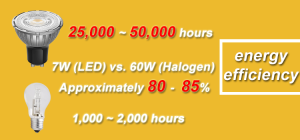
Remplacer un spot halogène de 50 W par une LED de 7 W réduit la consommation d'énergie d'environ 85 %.
2. Durée de vie et maintenance
Durée de vie des halogènes :
1 000–2 000 heures
Durée de vie des LED :
25 000 à 50 000 heures
Cette différence a un impact significatif sur les coûts de maintenance — notamment dans :
- Environnements de vente au détail
- Projets d'hôtellerie
- Plafonds hauts
- Installations commerciales
Frequent halogen replacement increases labor cost and downtime.
Source reference:
Energy Star Product Performance Requirements
https://www.energystar.gov/products/lighting_fans/light_bulbs
3. Heat Output and Safety
Halogen bulbs operate at extremely high temperatures:
- Filament temperature: 2,500–3,000°C
- Outer glass temperature: can exceed 200–500°C
High heat increases:
- Burn risk
- Fire hazard
- HVAC load
LED spotlights operate at significantly lower surface temperatures due to higher energy conversion efficiency.
In enclosed fixtures or insulated ceilings, heat accumulation becomes a serious concern with halogen.
4. Light Quality and Color Rendering
One historical advantage of halogen bulbs:
CRI (Color Rendering Index) is naturally close to 100.
LED technology has significantly improved:
- Standard LED CRI: 80–90
- High-end LED CRI: 95+
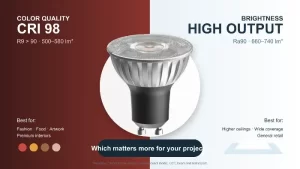
For professional retail or hospitality projects, high-CRI LEDs now match halogen color fidelity while maintaining efficiency.
CRI definition reference:
Commission internationale de l'éclairage (CIE)
https://cie.co.at/
Color quality explanation:
DOE – Color Quality of Light
https://www.energy.gov/eere/ssl/color-quality
5. Environmental Impact
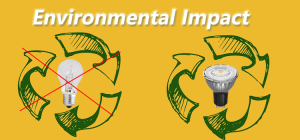
Energy consumption directly influences carbon footprint.
According to the U.S. DOE:
Switching to LED lighting in the U.S. could save hundreds of terawatt-hours of electricity annually, significantly reducing greenhouse gas emissions.
Source :
DOE Solid-State Lighting Report
https://www.energy.gov/eere/ssl
Additionally, the European Union has phased out many halogen lamps due to efficiency regulations.
EU Ecodesign Lighting Regulation:
https://energy-efficient-products.ec.europa.eu/ecodesign-and-energy-label/legislative-framework_en
This reflects global regulatory movement away from halogen technology.
6. 5-Year Total Cost Comparison
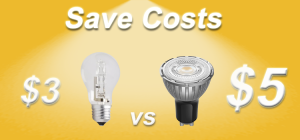
Assume:
- Daily use: 5 hours
- Electricity cost: $0.15 per kWh
Halogen (50W)
Energy use per year:
50W × 5h × 365 = 91.25 kWh
Annual energy cost ≈ $13.69
Plus multiple replacements over 5 years.
LED (7W)
Energy use per year:
7W × 5h × 365 = 12.78 kWh
Annual energy cost ≈ $1.92
Over 5 years, energy savings exceed initial price difference.
Total cost of ownership strongly favors LED.
7. When Might Halogen Still Be Used?
Despite efficiency disadvantages, halogen may still be chosen when:
- Perfect dimming curve is required
- Extremely low upfront cost is critical
- Existing legacy systems are not LED compatible
However, compatibility issues can often be resolved with proper LED driver selection.
8. Professional Recommendation Summary
For most applications in 2026:
LED spotlights offer:
- Dramatically higher efficiency
- Significantly longer lifespan
- Lower operating cost
- Reduced heat risk
- Conformité réglementaire
Halogen’s primary advantage — color rendering and dimming smoothness — is now achievable with modern high-CRI dimmable LED systems.
Conclusion
Halogen bulbs are not “bad” technology — but they are outdated in efficiency-driven environments.
For residential, retail, hospitality, and commercial projects, LED spotlights provide measurable advantages in:
- Energy savings
- Maintenance reduction
- Sécurité
- Environmental compliance
- Long-term operating cost
Choosing between LED and halogen is no longer primarily about light quality — it is about efficiency and total lifecycle performance.
Upgrading from halogen to LED requires attention to:
- Beam angle equivalency
- Color temperature matching
- Compatibilité avec la gradation
- Enclosed fixture heat conditions
- Driver stability
Before large-scale retrofits, technical evaluation can prevent flicker issues, premature failure, or light distribution mismatch.
If you are planning a halogen-to-LED conversion project and require engineering guidance on:
- GU10 or MR16 replacements
- High-CRI spotlight selection
- Dimming system compatibility
- Commercial retrofit specification
Our technical team can assist with optical matching and driver evaluation to ensure smooth transition and long-term reliability.
Provide your existing fixture type, dimmer model, and project scope for professional assessment.