Lâmpadas com Sensor de Movimento por Micro-ondas GU10: Como Funcionam e Onde Utilizá-las
Corredores, escadarias, entradas, garagens e zonas de serviço têm frequentemente o mesmo problema de iluminação: as lâmpadas permanecem acesas durante horas, mesmo quando ninguém está a usar o espaço. Substituir a luminária completa por um acessório com sensor pode resolver o problema, mas pode exigir re-cablagem, trabalho no teto, aprovação do dispositivo e um orçamento de remodelação maior.
Uma lâmpada GU10 com sensor de movimento de micro-ondas oferece uma solução mais compacta. Em vez de adicionar um sensor externo ou substituir a luminária completa, o sensor está integrado na própria lâmpada. Quando o suporte GU10 existente e a luminária são adequados, a equipa do projeto pode adicionar comutação automática substituindo a lâmpada.
Isso não significa que todas as luminárias GU10 devam usar uma lâmpada com sensor. A deteção por micro-ondas pode ser sensível, os materiais da luminária podem afetar o comportamento do sensor, e a lâmpada é geralmente concebida para controlo automático de ligar/desligar, e não para dimerização ou controlo de cenas. Para compradores B2B, a verdadeira questão não é apenas "Liga-se?", mas sim "A gama de deteção, o tempo de atraso, a dispersão do feixe, a posição da luminária e o comportamento de falsa ativação funcionarão no edifício real?"
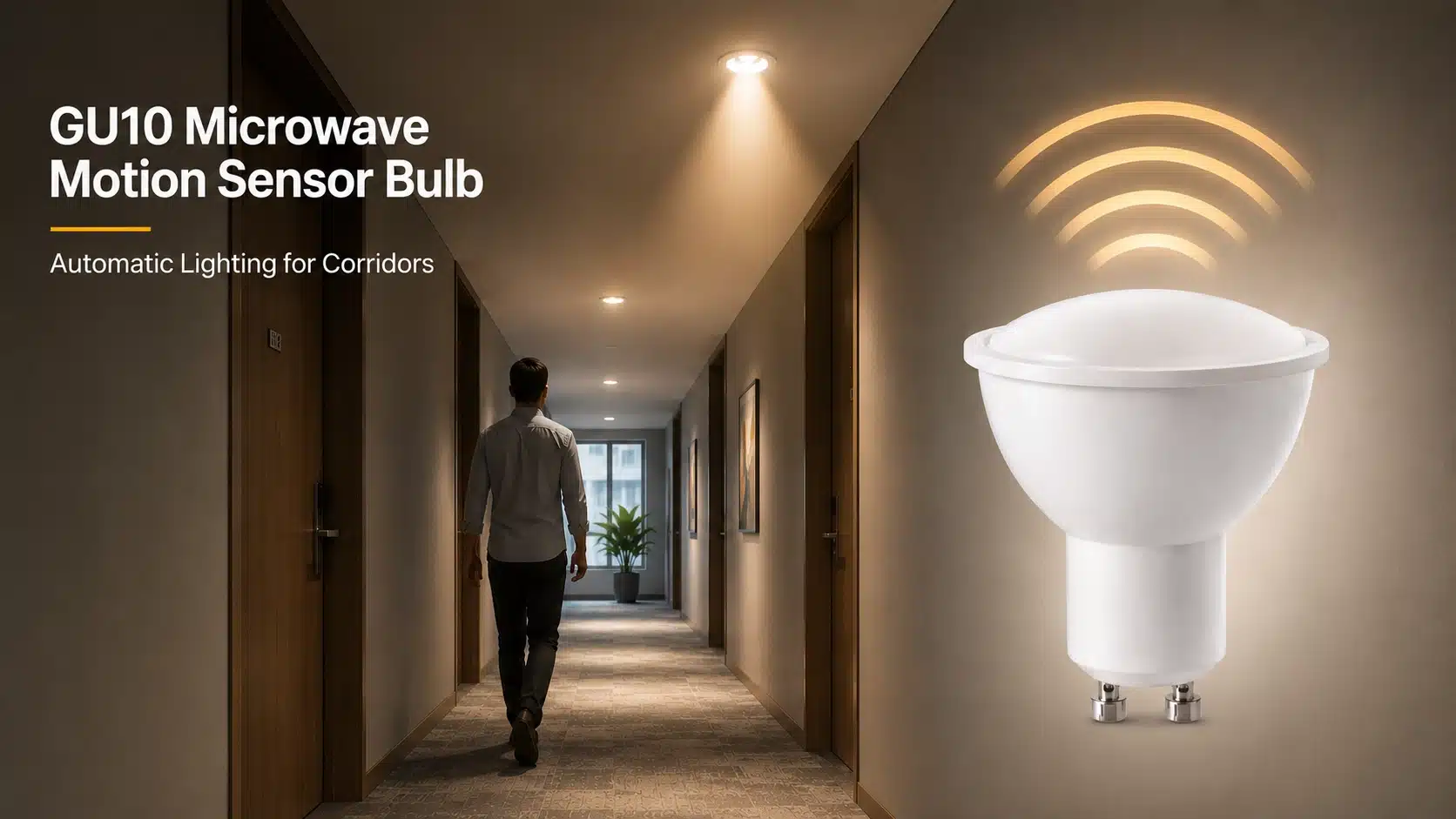
Lâmpada GU10 com sensor de movimento de micro-ondas para retrofit de iluminação de corredor
O que é uma Lâmpada GU10 com Sensor de Movimento por Micro-ondas?
Uma lâmpada GU10 com sensor de movimento de micro-ondas continua a ser uma lâmpada LED GU10. Utiliza a base GU10 padrão de encaixe por rotação e é instalada numa tomada GU10 compatível com tensão da rede. A diferença é que a lâmpada também contém um sensor de movimento de micro-ondas, um driver e um circuito de controlo.
Quando é detetado movimento, a lâmpada liga-se automaticamente. Após o último movimento detetado, a lâmpada permanece ligada durante um período de atraso definido e depois desliga-se. Algumas lâmpadas com sensor também incluem deteção de luz diurna, para que a lâmpada não se ligue desnecessariamente quando o espaço circundante já estiver suficientemente iluminado.
A lâmpada GU10 com sensor de movimento de micro-ondas Essential Plastic da TECO é uma lâmpada GU10 não dimerizável de 7W, com ângulo de feixe de 120 graus, entrada 100-240Vac, funcionamento sem cintilação e opções de lúmens listadas de 640lm, 740lm e 800lm, dependendo da CCT. A página do produto lista opções de 2700K, 3000K e 4000K, CRI80, dimensões de 50 x 53 mm, e distância de deteção, tempo de atraso e deteção de intensidade de luz personalizáveis para requisitos do projeto.1
| Componente | Função na Lâmpada com Sensor |
|---|---|
| Base GU10 | Liga-se ao suporte de tensão da rede existente |
| Fonte de luz LED | Fornece a iluminação real |
| Sensor de micro-ondas | Deteção de movimento através de alterações no sinal de micro-ondas refletido |
| Driver e circuito de controlo | Alimenta o LED e gere a comutação automática |
| Deteção de luz diurna | Ajuda a evitar ativação desnecessária em condições de luz forte |
| Configuração de atraso | Controla quanto tempo a lâmpada permanece acesa após movimento |
Este produto não deve ser tratado como uma lâmpada de controlo por voz, uma lâmpada PIR, um foco regulável ou uma luz de emergência. É melhor entendido como uma lâmpada LED GU10 com comutação automática por movimento incorporada.
Como Funciona a Deteção de Movimento por Micro-ondas
A deteção por micro-ondas é um método de deteção ativo. O sensor emite um sinal de micro-ondas de baixa potência e monitoriza o sinal refletido. Quando uma pessoa, veículo, porta ou objeto se move dentro da área de deteção, o sinal refletido altera-se. O circuito de controlo interpreta essa alteração como movimento e liga a lâmpada.
A deteção PIR funciona de forma diferente. Os sensores PIR são dispositivos de infravermelhos passivos que respondem a alterações na radiação infravermelha no seu campo de visão. Os sensores de micro-ondas enviam e recebem ativamente sinais, enquanto os sensores PIR detetam alterações nos padrões de radiação térmica. Esta diferença é a razão pela qual os sensores de micro-ondas podem por vezes detetar movimentos mais pequenos ou movimento através de certos materiais não metálicos, enquanto os sensores PIR geralmente precisam de uma linha de visão mais clara para o corpo quente em movimento.
Para os compradores de iluminação, o significado prático é simples:
- sensores de micro-ondas detetam movimento, não som
- não dependem apenas do calor corporal
- podem responder a pequenos movimentos mais facilmente do que os PIR
- podem detetar movimento para além da área visível pretendida em algumas instalações
- metal, dispositivos profundos e a construção circundante podem alterar o resultado da detecção
O relatório de fiabilidade de sensores do Departamento de Energia dos EUA nota que o desempenho dos sensores de ocupação é comumente avaliado através do campo de visão, distância de deteção e métodos de teste repetíveis, e que os protocolos NEMA cobrem PIR, bem como tecnologias de deteção ativa, como dispositivos ultrassónicos e de micro-ondas.2 Isto é importante porque o desempenho do sensor não é apenas um número da ficha técnica. Está fortemente ligado à geometria da instalação.
As lâmpadas com sensor de micro-ondas conseguem detetar através de paredes ou portas?
Às vezes, mas isto deve ser tratado com cuidado. Os sinais de micro-ondas podem passar através de ou serem afetados por alguns vidros, plásticos, madeiras finas ou revestimentos leves não metálicos. O metal geralmente reflete ou protege o sinal. A espessura da parede, o material, a sensibilidade do sensor, a direção de montagem e o design do dispositivo afetam o resultado.
Isto pode ser uma vantagem em certas luminárias fechadas onde o sensor está escondido atrás de uma cobertura de plástico ou vidro. Também pode tornar-se um problema se a lâmpada detetar movimento atrás de uma divisória fina, fora de uma porta ou num corredor adjacente.
A formulação correta não é "os sensores de micro-ondas conseguem ver através de paredes." Uma declaração de projeto melhor é: a deteção por micro-ondas pode estender-se para além da abertura visível do dispositivo, dependendo do material e das condições de instalação, pelo que é necessário testar amostras antes da instalação em massa.
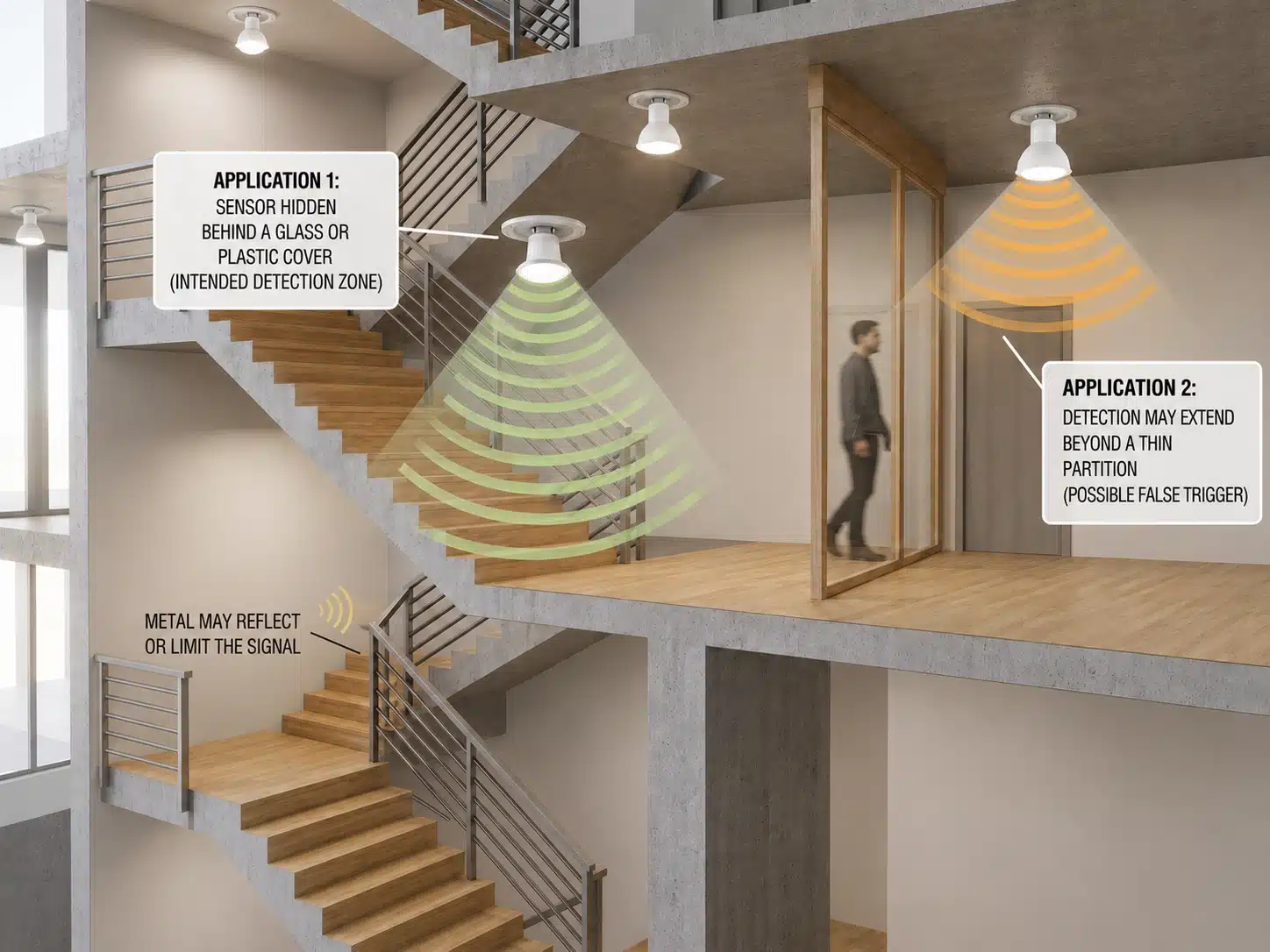
Detecção da lâmpada GU10 com sensor de micro-ondas na iluminação de corredores e escadarias
Sensor de Micro-ondas vs Sensor PIR: Qual é a Diferença?
Os sensores de micro-ondas e PIR não são simplesmente "melhores" ou "piores". Resolvem problemas diferentes do projeto. Um sensor de micro-ondas pode ser útil quando é importante uma deteção de movimento subtil, instalação oculta ou deteção através de algumas coberturas não metálicas. O PIR pode ser melhor quando o projeto precisa de uma zona de deteção mais claramente limitada, com menor risco de ativação a partir de áreas adjacentes.
| Fator | Sensor de Micro-ondas | Sensor PIR |
|---|---|---|
| Princípio de deteção | Envia e recebe sinais de micro-ondas | Deteção de alterações na radiação infravermelha |
| Tipo de sensor | Ativo | Passivo |
| Detecção de movimento fino | Often sensitive to small movement | Usually needs clearer body movement |
| Temperature influence | Less dependent on body-to-air temperature difference | More affected by thermal contrast |
| Through-cover behavior | May work through some glass or plastic | Usually needs clearer field of view |
| False-trigger risk | May detect beyond intended zone | Usually more limited by line of sight |
| Power use | Typically higher than PIR sensing | Typically lower |
| Common use | Corridors, stairways, enclosed fixtures, service zones | Rooms, entries, outdoor security fittings |
For a single small corridor, stair landing, or service-room retrofit, a GU10 microwave sensor bulb can be a practical solution. For a large office, hotel floor, warehouse aisle, or coordinated building-control zone, an external sensor or networked control system may be more appropriate.
NEMA describes lighting controls as a broad category including photocells, sensors, dimmers, timers, relays, and systems used to reduce energy use, improve safety, and increase flexibility across indoor and outdoor spaces.3 A sensor bulb belongs to that wider control family, but it is still a localized product, not a full lighting control system.
Where GU10 Microwave Sensor Bulbs Work Best
The strongest use case is a localized retrofit where automatic lighting is helpful, the existing GU10 holder remains usable, and replacing the full fixture would be unnecessary. This is why sensor GU10 bulbs are often more valuable in circulation and support spaces than in decorative accent lighting.
Good applications include:
| Aplicação | Why It Can Work Well |
|---|---|
| Corridors | Short occupancy periods and repeated passing traffic |
| Stairways | Hands-free switching improves convenience and safety |
| Entrances | Automatic lighting when people arrive or leave |
| Garages | Intermittent use and practical wide-area visibility |
| Service rooms | Staff may enter briefly and forget to switch lights off |
| Storage rooms | Lighting is needed only during access periods |
| Apartment common areas | Retrofit-friendly automatic lighting without full fixture replacement |
| Hotel back-of-house areas | Practical lighting for service passages and utility zones |
TECO’s model uses a 120 degree beam, which is different from a narrow GU10 spotlight. A standard GU10 used for accent lighting may have a 24 degree, 36 degree, or 60 degree beam. A 120 degree beam is broader and more suitable for passage lighting, stair zones, entries, and utility spaces where people need general visibility rather than a tight spotlight effect.
| Tipo de Feixe | Typical Effect | Better Use |
|---|---|---|
| 24 degree | Narrow, concentrated spot | Product accent lighting |
| 36 degree | Controlled spotlight | Retail or recessed accent lighting |
| 60 degree | Wider spotlight | Small spaces and broader accents |
| 120 degree | Broad flood coverage | Corridors, stairs, garages, entrances |
This means the lamp should not be specified as a premium display spotlight or decorative beam-control product. It is a functional automatic lighting bulb for movement-based switching and broad coverage.
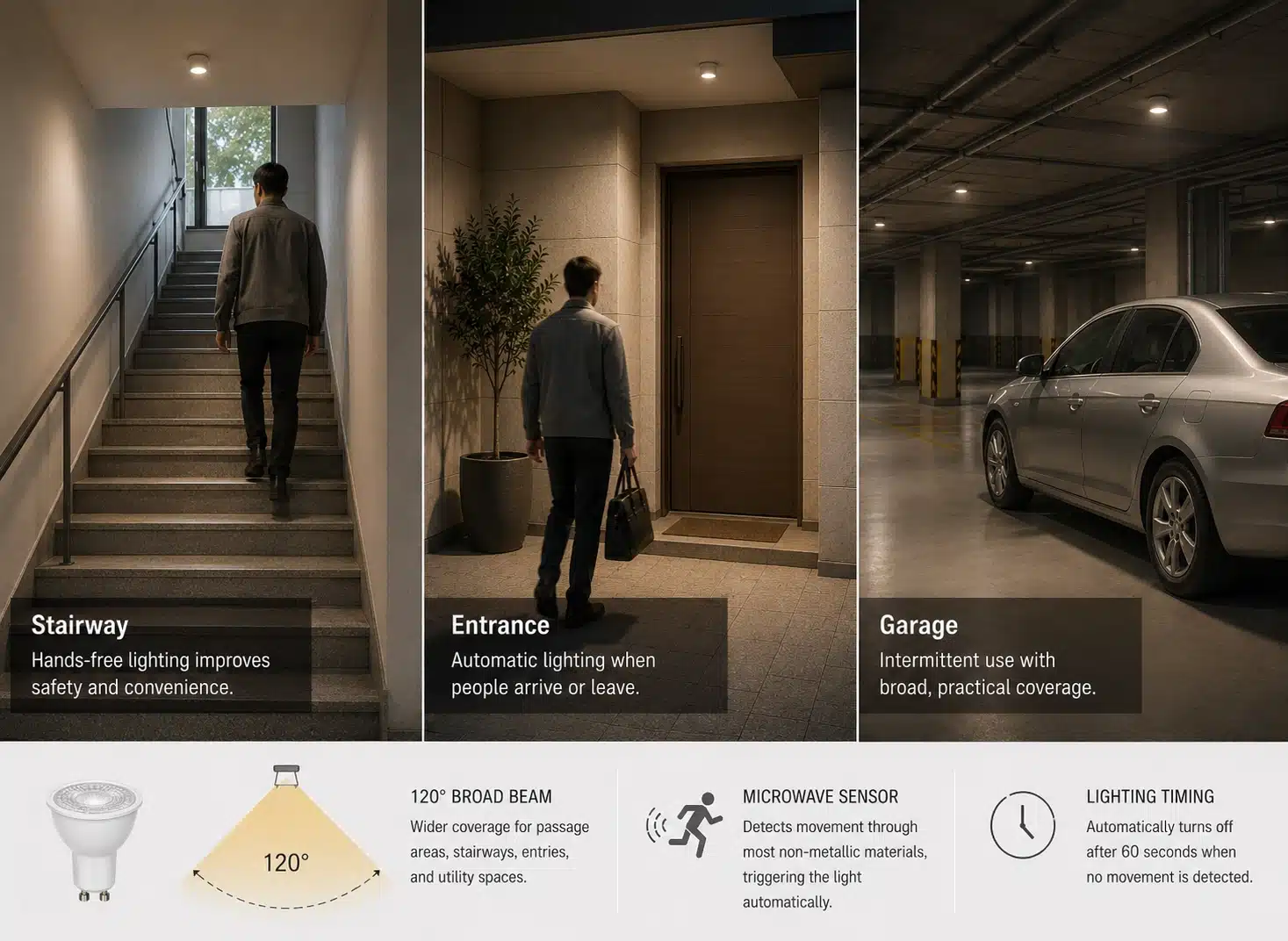
GU10 microwave sensor bulb for stairway entrance and garage lighting
Where You Should Not Use a Microwave Sensor GU10 Bulb
The most professional advice is sometimes to say no. A motion sensor bulb is useful only when automatic switching matches the space behavior.
Avoid using this type of lamp in:
- areas that need continuous stable lighting, such as workstations or desks
- spaces that need dimming, scene setting, or ambience control
- restaurants, hotel rooms, lounges, or retail displays where lighting mood matters
- narrow areas where the sensor may detect movement through a wall or door
- locations with moving fans, machines, vehicles, or doors that may create false triggers
- fully metal-enclosed luminaires that may block or distort microwave sensing
- damp, outdoor, or wet areas unless the full product and fixture have suitable ratings
- emergency lighting, exit lighting, or life-safety systems
- multi-lamp zones where every lamp must switch on and off in a coordinated way
TECO’s product is explicitly listed as non-dimmable.1 It should not be connected to a standard Triac dimmer or used where dimming compatibility is required. If the front end already has an external motion sensor, timer, smart relay, or building-control system, the project team should check whether adding a second sensor inside each bulb creates control conflict.
A good rule is this: use a sensor bulb for simple localized automatic switching; use a proper control system when the building needs coordinated zones, dimming, schedules, overrides, or central management.
The Sensor Parameters Buyers Must Confirm
For bulk orders, sensor behavior matters as much as wattage and lumens. Two bulbs with the same GU10 base can create very different user experiences if their delay time, detection distance, daylight threshold, or re-trigger behavior differs.
| Parâmetro | Why It Matters in Projects |
|---|---|
| Detection distance | Too short creates dark entry moments; too long may detect adjacent areas |
| Delay / hold time | Too short causes repeated off/on; too long reduces energy savings |
| Daylight threshold | Prevents the lamp from switching on in bright conditions |
| Installation height | Changes real detection coverage and response behavior |
| Fixture material | Metal, glass, or plastic may change microwave transmission |
| Fixture depth | A deeply recessed GU10 may limit sensor performance |
| Re-trigger behavior | Determines whether timing resets when movement continues |
| Multi-lamp sequence | Prevents awkward staggered switching in corridors |
| Ambient movement | Fans, doors, vehicles, and machinery may trigger the sensor |
One overlooked issue is re-trigger logic. In a corridor, the lamp should normally remain on if movement continues. If the delay time expires while the person is still nearby, the user may see uncomfortable repeated switching. For stairways, both upward and downward movement should be tested because detection may differ by approach direction.
Daylight threshold also deserves attention. If it is too high, the lamp may switch on during the day and waste energy. If it is too low, it may fail to activate at dusk or in a dim interior. For buildings with skylights, glass doors, or mixed daylight, one setting may not behave the same throughout the day.
Fixture Compatibility Is More Than the GU10 Base
Being able to twist the bulb into a GU10 holder does not guarantee sensor performance. The lamp, fixture, and space must work together.
Buyers should check four compatibility layers:
| Compatibility Layer | What to Check |
|---|---|
| Mechanical fit | 50 x 53 mm lamp body, holder depth, trim clearance |
| Electrical input | 100-240Vac supply, non-dimmable circuit, stable connection |
| Sensor transmission | Fixture material, metal shielding, glass or plastic covers |
| Thermal condition | Heat buildup around the LED, driver, and sensor electronics |
Deep recessed fittings can hide the lamp body and change the detection area. Metal housings may reflect or block microwave signals. Thick covers may reduce sensitivity. Very open fixtures may allow the sensor to detect too broadly. These effects are not always visible from the product photo.
For retrofit projects, the safest method is to install samples in the real fixture and test the real walking path. A sample tested on an open desk does not prove that it will behave correctly inside a ceiling fitting, garage fixture, or stairwell luminaire.
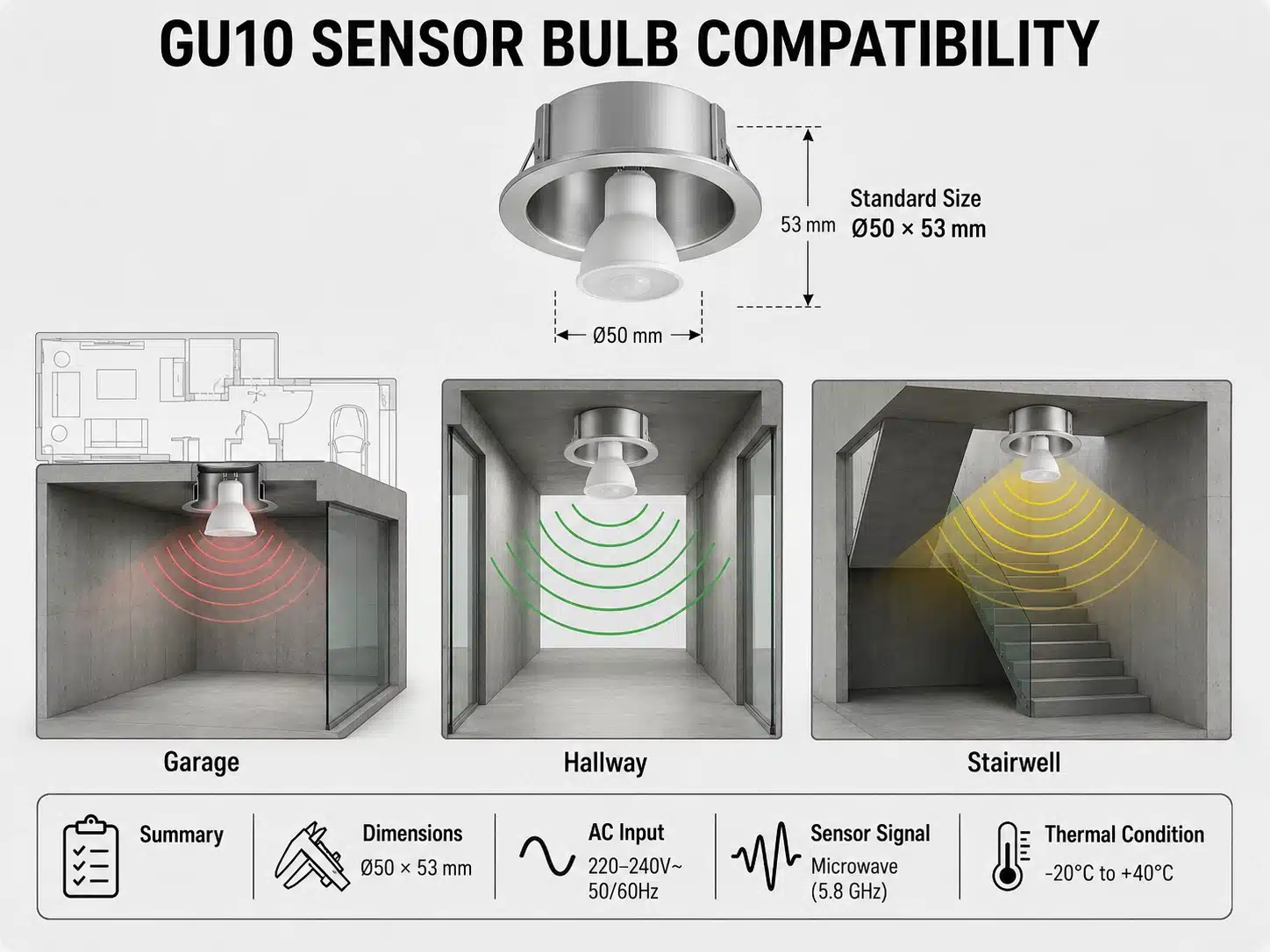
GU10 microwave motion sensor bulb fixture compatibility and installation testing
Common Installation Problems and False Triggers
Most complaints about sensor bulbs come from installation mismatch rather than a simple lamp defect. The lamp may work exactly as designed, but the sensing zone does not match the space.
Problemas comuns incluem:
| Problema | Possible Cause | Project Fix |
|---|---|---|
| Lamp stays on too long | Delay time too long or continuous movement nearby | Adjust delay or change location |
| Lamp turns on through a door | Microwave detection extends beyond target zone | Reduce range, relocate lamp, or use different control method |
| Lamp does not turn on quickly | Sensor shielded by fixture or installed in poor direction | Test fixture material and position |
| Lamp triggers from fans or vehicles | Moving objects inside detection range | Change sensing distance or application |
| Multiple bulbs switch unevenly | Each bulb detects independently | Use fewer sensor bulbs or external zone control |
| Lamp flickers on dimmer | Product is non-dimmable | Remove dimmer or use a suitable non-dim circuit |
For hotel corridors or apartment common areas, staggered switching can look unprofessional if each bulb activates independently. In a short passage, this may be acceptable. In a long corridor, an external sensor controlling multiple standard GU10 lamps may create a smoother result.
For garages, vehicles may trigger the light before a person enters. That can be useful, but it may also keep the light active longer than expected. For service rooms, moving equipment or ventilation can sometimes create unexpected activation. This is why a site mockup is more valuable than arguing from a detection-distance number alone.
Integrated Sensor Bulb vs External Motion Sensor
An integrated GU10 sensor bulb is attractive because it keeps the retrofit simple. But it is not always the best engineering answer.
| Fator | Integrated GU10 Sensor Bulb | External Sensor + Standard GU10 |
|---|---|---|
| Retrofit complexity | Usually lower | May require rewiring |
| Control zone | Each bulb usually works independently | One sensor can control several lamps |
| Visual appearance | No obvious external sensor | External sensor may be visible |
| Commissioning flexibility | Limited by bulb design | Usually more adjustable |
| Maintenance | Sensor and lamp replaced together | Sensor and lamp serviced separately |
| Large project suitability | Good for simple localized retrofits | Better for coordinated zones |
For small zones, individual sensor bulbs can be very convenient. For long corridors, hotel floors, office common areas, or multi-lamp stairwells, a dedicated external sensor may provide better zone control. The right solution depends on whether the buyer wants simple lamp-level automation or a coordinated building-control result.
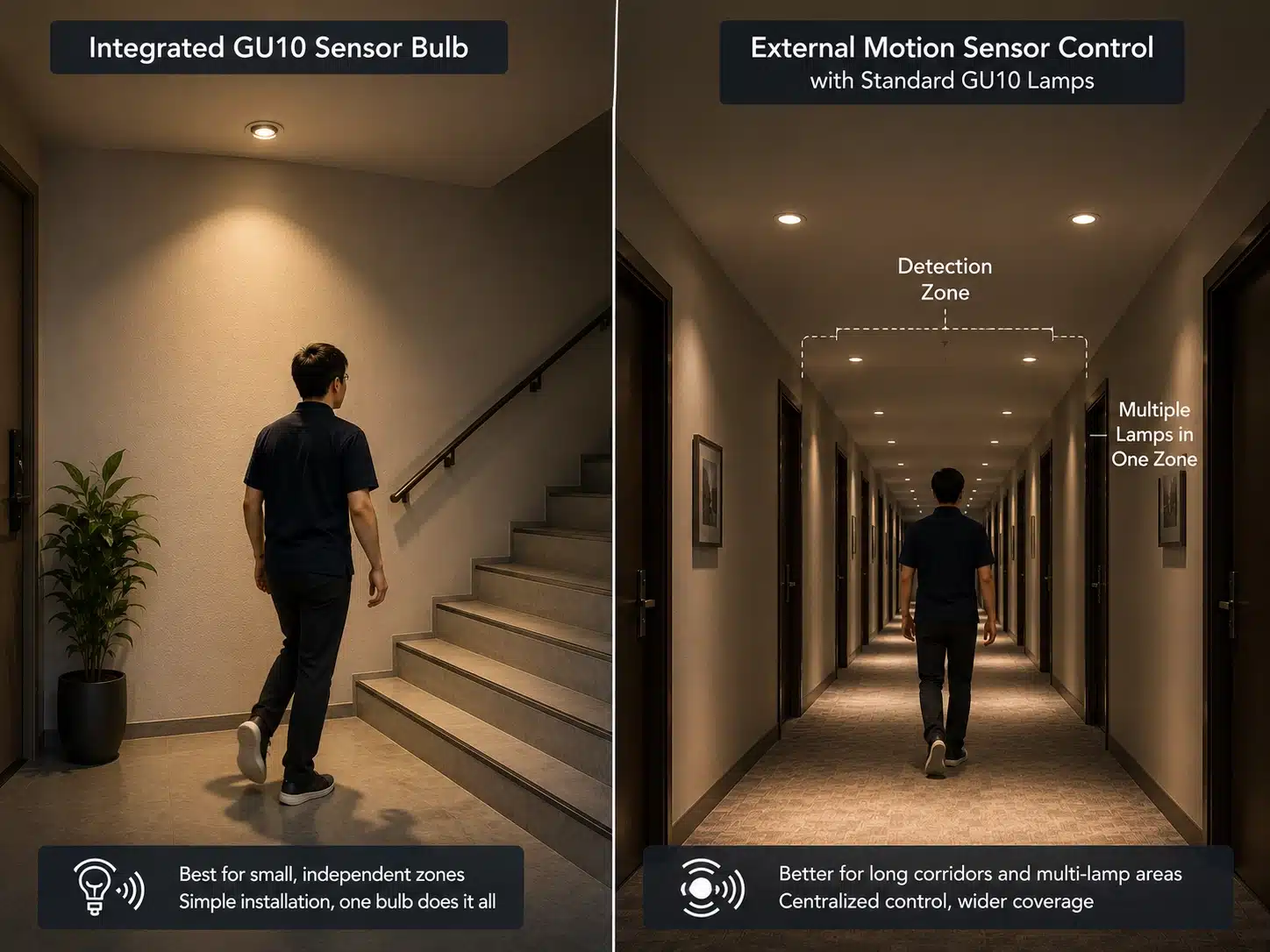
Integrated GU10 sensor bulb versus external motion sensor lighting control
What B2B Buyers Should Test Before Bulk Orders
Before ordering sensor GU10 bulbs in quantity, buyers should test the product as a system: lamp, fixture, building material, mounting height, walking path, daylight condition, and electrical circuit.
| Test Item | What to Confirm |
|---|---|
| GU10 fit | Lamp fits the holder, trim, and fixture depth |
| Alcance de deteção | No missed detection or adjacent-area triggering |
| Hold time | Matches real walking and occupancy pattern |
| Daylight threshold | Does not switch on unnecessarily during daytime |
| Fixture material | Metal, glass, or plastic does not create unexpected behavior |
| Installation height | Detection works at the real ceiling or wall position |
| Multiple lamps | Activation sequence looks acceptable |
| Heat | Lamp remains stable in the intended fixture |
| Tensão | Stable operation on the target market supply |
| Beam coverage | 120 degree beam covers the required floor or passage area |
| Batch consistency | Sensor behavior remains consistent across production |
| Certificação | Meets destination-market requirements |
For a serious inquiry, buyers should send TECO the fixture photo, installation height, corridor or room dimensions, number of lamps per area, target sensing distance, preferred delay time, daylight requirement, voltage market, and estimated order quantity. This gives the team enough information to recommend a sample configuration and avoid treating the product as a generic GU10 replacement.
Conclusão
GU10 microwave motion sensor bulbs are most useful in localized retrofit projects where automatic lighting is needed without replacing the complete fixture. They can work well in corridors, stairways, entrances, garages, service rooms, apartment common areas, and hotel back-of-house zones.
The key is to specify them as sensor-control products, not as ordinary GU10 spotlights. Detection range, delay time, daylight threshold, fixture material, installation height, beam coverage, false-trigger risk, and multi-lamp behavior must all be checked before bulk installation.
For TECO project buyers, the best next step is not only to ask for price. Send the fixture type, installation position, sensing requirement, delay-time preference, daylight condition, and estimated quantity so the right GU10 microwave sensor bulb sample can be tested before production.
Notas de rodapé
Product specifications are based on TECO’s product page for the Essential Plastic GU10 Microwave Motion Sensor Light Bulb, including 7W power, 100-240Vac input, 120 degree beam angle, non-dimmable operation, 640lm / 740lm / 800lm flux options, and customizable sensing settings. See TECO GU10 Microwave Motion Sensor Spotlight 7W 120D. ↩ ↩
The U.S. Department of Energy report on occupancy sensor reliability discusses field of view, detection distance, repeatable test methods, and the use of NEMA protocol for PIR and active sensors such as ultrasonic and microwave devices. See DOE Evaluation of the Reliability of PIR Occupancy Sensors. ↩
NEMA describes lighting controls as devices and systems including sensors, photocells, dimmers, timers, relays, and other controls used to reduce energy consumption, improve safety, and increase flexibility. See NEMA Lighting Controls. ↩