调光至暖光GU10照明如何在酒店和家庭中营造更佳氛围
照明直接影响人们在空间中的感受。在现代建筑和室内设计中,照明不再仅仅是关于可见性——它已成为氛围、情感和空间特性的可控媒介。.
氛围照明中最重要的创新之一是 调光暖色LED技术, ,使光源在调暗时能转向更暖的色温,实现从功能性照明到放松氛围照明的自然过渡。.
与固定色温LED不同,调光暖色并非由单一色温范围定义,而是通过 行为原理:相关色温(CCT)随亮度降低而动态下降.
什么是调光至温暖照明技术?
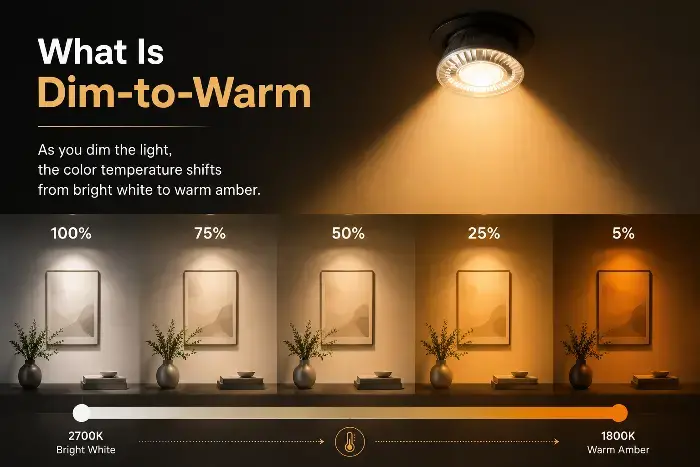
调光至温暖照明 是一种LED控制方法,调光时发出的光线会逐渐变得更温暖。.
这种行为模仿了传统的白炽灯或卤素灯,较低的功率输出自然会导致更温暖的光谱外观。.
调光暖色系统并非保持固定色温(如2700K或3000K),而是创造 连续色温过渡曲线 在调光过程中。.
核心概念:
调光至温暖 = 亮度变化 + 相关色温偏移
调光暖色技术在LED系统中的工作原理
调光至温暖的GU10 LED射灯通常采用 双通道或多通道LED架构, ,结合智能驱动器控制。.
工作原理:
- 一个温暖的LED通道和一个中性/冷色通道集成在一个光源引擎中
- 调光过程中,通道平衡动态变化
- 光谱输出逐渐向更温暖的波长移动
先进的驱动器功能可能包括:
- 高分辨率电流控制(平滑调光曲线)
- PWM或混合调光控制
- 热补偿确保稳定的色度偏移
- 深度调光能力(在高端设计中可低至1%或更低)
高品质系统还需确保:
- 无频闪性能(低Pst LM / 符合IEEE 1789标准的设计)
- 在整个调光范围内保持稳定的色度
- 平滑、无阶梯感的视觉过渡
常见调光暖色温过渡范围
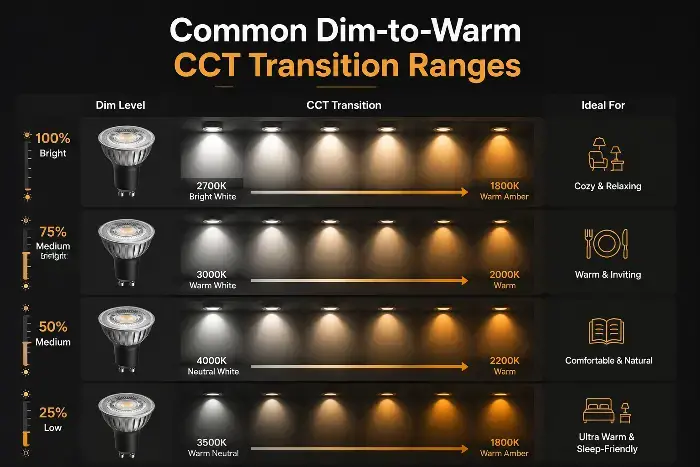
调光至暖色并非仅限于单一色温范围。根据设计意图和照明氛围要求,不同应用会采用不同的过渡曲线。.
| 应用类型 | 典型色温过渡范围 | 设计意图 |
|---|---|---|
| 住宅温馨照明 | 3000K → 2200K | 舒适的日常生活 |
| 酒店标准照明 | 2700K → 2200K | 平衡的环境氛围 |
| 酒店氛围照明 | 2700K → 1800K | 放松与奢华感 |
| 高端建筑照明 | 3000K → 1800K | Strong emotional transition |
| Ultra-Warm Ambient Lighting | 2700K → 1600K | Candle-like decorative effect |
关键见解:
Dim-to-warm performance is defined more by its transition behavior and curve quality than by fixed endpoint values.
Why Atmosphere Matters in Lighting Design
In both hospitality and residential environments, lighting is a critical component of spatial perception.
Lighting influences:
- Emotional comfort
- Perceived material quality
- Spatial depth and contrast
- User behavior and dwell time
Well-designed ambient lighting helps transform a space from purely functional to emotionally engaging.
Why Dim-to-Warm Is Ideal for Hospitality Design
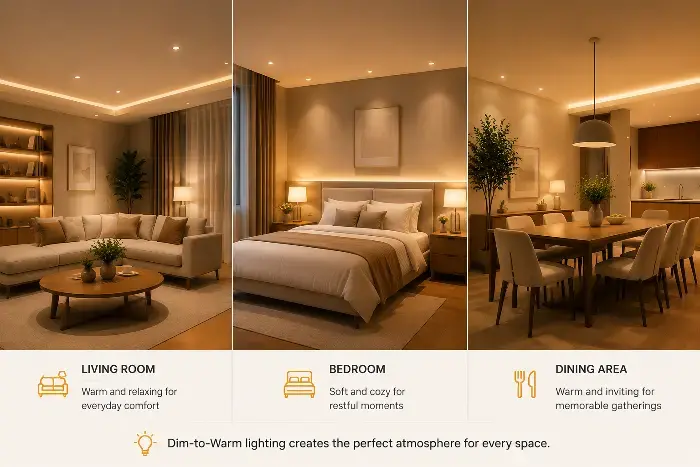
Hotels and hospitality environments rely heavily on lighting to shape guest experience across different time periods and usage scenarios.
Guest Rooms
- Smooth transition from functional lighting to relaxation mode
- Supports winding-down behavior without switching fixtures
Lobbies
- Creates warm first impressions
- Enhances perceived luxury and brand identity
Corridors
- Soft low-glare navigation lighting
- Improved visual comfort and reduced harsh contrast
Restaurants and Bars
- Adaptive mood lighting for different service phases
- Enhances food presentation and social atmosphere
Dim-to-warm systems reduce the need for multiple fixtures with different CCTs, simplifying architectural lighting design.
Why Dim-to-Warm Works in Residential Spaces
Residential lighting requires flexibility across different times of day and human activities.
Living Rooms
- Bright neutral warm light for daytime use
- Softer warm tones for evening relaxation
卧室
- Ultra-warm low-intensity lighting for pre-sleep comfort
- Supports relaxation-oriented environments
用餐区域
- Adjustable ambiance for social or functional use
- Enhances material perception and food appearance
Dim-to-warm GU10 simplifies lighting control without requiring complex smart lighting infrastructure.
Why Metal GU10 Design Matters
Many professional dim-to-warm GU10 products use a metal cup optical and thermal structure, which provides both performance and reliability advantages.
1. 热管理
Efficient heat dissipation helps:
- Stabilize LED junction temperature
- Maintain consistent chromaticity over time
- Extend system lifespan and lumen maintenance performance
2. Optical Control
Metal reflector structures improve:
- Beam accuracy and directionality
- Reduction of stray light
- Higher contrast accent lighting performance
3. Visual Comfort and Glare Control
Well-designed optical systems contribute to:
- Softer beam cut-off
- Improved visual comfort in architectural spaces
- More premium “lighting without glare” perception
Dim-to-Warm vs Fixed CCT GU10
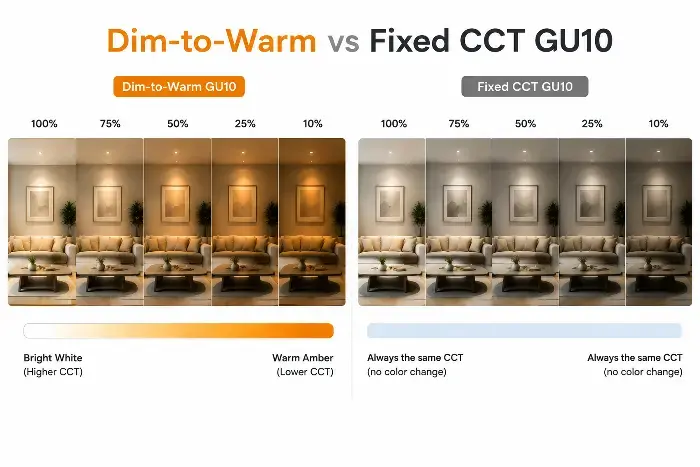
| 特点 | Fixed CCT GU10 | Dim-to-Warm GU10 |
|---|---|---|
| Color Temperature Behavior | Static | Dynamic shift |
| Dimming Output | Brightness only | Brightness + CCT change |
| Atmosphere Control | 有限 | High flexibility |
| Design Application | Functional lighting | Experience-driven lighting |
| Architectural Value | Basic | 高端 |
Dim-to-warm lighting consolidates multiple lighting scenes into a single luminaire, significantly improving design efficiency.
Applications of Dim-to-Warm GU10 Lighting
Hospitality Sector
- Hotel guest rooms
- Suites and premium rooms
- Lobbies and reception areas
- Restaurants and lounges
Residential Sector
- 客厅
- 卧室
- Dining spaces
Commercial and Retail
- Boutique stores
- Jewelry lighting
- Luxury product displays
Entertainment Spaces
- Bars and lounges
- Mood-based environments
- Experience-driven venues
Engineering Insight: Why Quality Matters in Dim-to-Warm Systems
Not all dim-to-warm GU10 products deliver the same performance quality. High-performance systems require precise engineering in:
- Color rendering stability (CRI typically > 90, R9 optimized for premium environments)
- Smooth dimming curves without visible steps
- Flicker control (low flicker index / IEEE 1789-aligned design principles)
- Deep dimming capability (down to very low light levels)
- Controlled CCT shift linearity across dimming range
Low-quality implementations may result in:
- Color inconsistency at low brightness
- Noticeable flicker during dimming
- Abrupt or non-linear color transitions
Is Dim-to-Warm the Same as Human-Centric Lighting?
Dim-to-warm lighting is often associated with comfort-oriented lighting design, but it is not a full human-centric lighting system.
Human-Centric Lighting typically includes:
- Dynamic circadian tuning throughout the day
- Automated lighting control systems
- Biological rhythm optimization strategies
Dim-to-warm focuses on:
- Warm emotional transition during dimming
- Visual comfort and atmospheric control
- Evening relaxation and hospitality experience
Dim-to-warm can be part of a broader human-centric lighting strategy but does not replace it.
常见问题
What is dim-to-warm lighting?
Dim-to-warm lighting is an LED technology where color temperature becomes warmer as brightness is reduced, simulating incandescent-like behavior.
Is dim-to-warm limited to a specific color temperature range?
No. Different products use different transition ranges such as 3000K→2200K, 2700K→1800K, or other engineered curves depending on application requirements.
Where is dim-to-warm lighting commonly used?
Hotels, restaurants, residential interiors, and high-end commercial environments.
Is dim-to-warm compatible with TRIAC dimmers?
Many professional GU10 dim-to-warm products support TRIAC (phase-cut) dimming systems, depending on driver design.
Why choose dim-to-warm over fixed CCT lighting?
It enables dynamic emotional lighting control within a single fixture, reducing design complexity and improving spatial experience.
结论
Dim-to-warm GU10 lighting represents a fundamental shift in architectural lighting design, moving from static illumination toward dynamic emotional control.
Rather than being defined by a single color temperature range, dim-to-warm technology is defined by its ability to create smooth, natural transitions in both brightness and color temperature simultaneously.
In hospitality environments, it enhances guest experience and spatial perception. In residential applications, it improves comfort and daily living quality. In commercial and architectural spaces, it enables more flexible and emotionally responsive lighting design.
As lighting continues to evolve toward experience-driven environments, dim-to-warm technology has become an essential tool for architects, designers, and lighting manufacturers.
Need Premium Dim-to-Warm GU10 Lighting Solutions for Your Project?
As an OEM/ODM lighting manufacturer, we support architectural and hospitality projects with engineered dim-to-warm solutions designed for performance, stability, and optical precision.
We offer:
- Flexible dim-to-warm CCT transition curves (various ranges available)
- High CRI options (CRI > 90 with optimized R9 performance)
- Metal cup optical structure for controlled beam performance
- Flicker-free, smooth deep dimming capability
- TRIAC / 0–10V / phase-cut compatibility options
Contact our engineering team to request:
- Free sample kit
- IES photometric files
- Technical datasheets
- Custom project consultation