كيف تخلق إضاءة GU10 القابلة للتعتيم إلى الدفء أجواءً أفضل في الفنادق والمنازل
Lighting has a direct impact on how people feel in a space. In modern architectural and interior design, illumination is no longer only about visibility—it is a controllable medium for atmosphere, emotion, and spatial identity.
Among the most important innovations in ambient lighting is dim-to-warm LED technology, which enables the light source to shift to a warmer color temperature as it is dimmed, creating a natural transition from functional lighting to relaxed, atmospheric lighting.
Unlike fixed-CCT LEDs, dim-to-warm is not defined by a single color temperature range. Instead, it is defined by a behavioral principle: correlated color temperature (CCT) dynamically decreases as brightness decreases.
What Is Dim-to-Warm Lighting Technology?
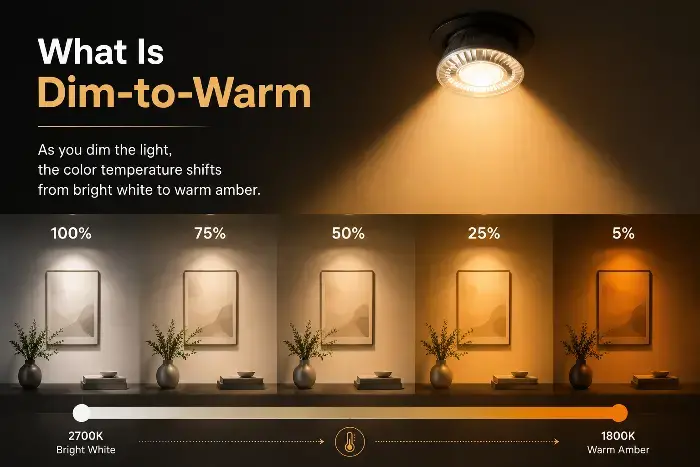
Dim-to-warm lighting is an LED control method where the emitted light becomes progressively warmer when dimmed.
This behavior mimics traditional incandescent or halogen lamps, where lower power output naturally results in a warmer spectral appearance.
Instead of maintaining a fixed CCT (such as 2700K or 3000K), dim-to-warm systems create a continuous CCT transition curve during dimming.
Key concept:
Dim-to-warm = brightness change + correlated color temperature shift
How Dim-to-Warm Technology Works in LED Systems
Dim-to-warm GU10 LED spotlights typically use a dual-channel or multi-channel LED architecture, combined with intelligent driver control.
Working principle:
- A warm LED channel and a neutral/cool channel are integrated in one light engine
- During dimming, channel balance shifts dynamically
- The spectral output gradually moves toward warmer wavelengths
Advanced driver features may include:
- High-resolution current control (smooth dimming curve)
- PWM or hybrid dimming control
- Thermal compensation for stable chromaticity shift
- Deep dimming capability (down to 1% or lower in premium designs)
High-quality systems also ensure:
- Flicker-free performance (low Pst LM / IEEE 1789 aligned design)
- Stable chromaticity across the full dimming range
- Smooth, non-stepped visual transition
Common Dim-to-Warm CCT Transition Ranges
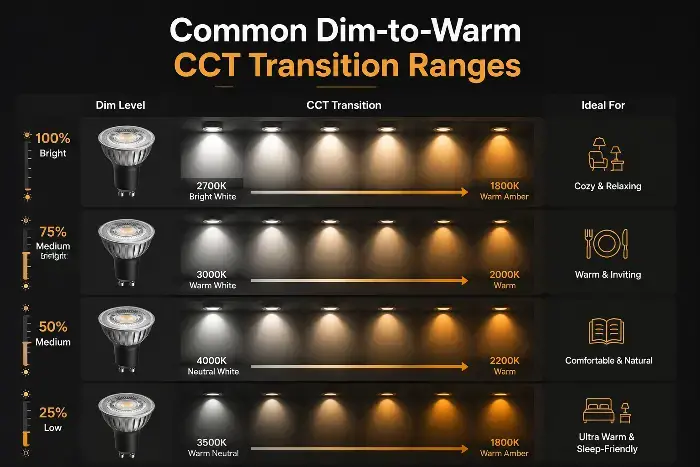
Dim-to-warm is not limited to a single color temperature range. Different applications use different transition profiles depending on design intent and lighting atmosphere requirements.
| Application Type | Typical CCT Transition Range | Design Intent |
|---|---|---|
| Residential Warm Lighting | 3000K → 2200K | Comfortable daily living |
| Hospitality Standard Lighting | 2700K → 2200K | Balanced ambient mood |
| Hospitality Atmospheric Lighting | 2700K → 1800K | Relaxation and luxury feel |
| High-End Architectural Lighting | 3000K → 1800K | Strong emotional transition |
| Ultra-Warm Ambient Lighting | 2700K → 1600K | Candle-like decorative effect |
رؤية رئيسية:
Dim-to-warm performance is defined more by its transition behavior and curve quality than by fixed endpoint values.
Why Atmosphere Matters in Lighting Design
In both hospitality and residential environments, lighting is a critical component of spatial perception.
Lighting influences:
- Emotional comfort
- Perceived material quality
- Spatial depth and contrast
- User behavior and dwell time
Well-designed ambient lighting helps transform a space from purely functional to emotionally engaging.
Why Dim-to-Warm Is Ideal for Hospitality Design
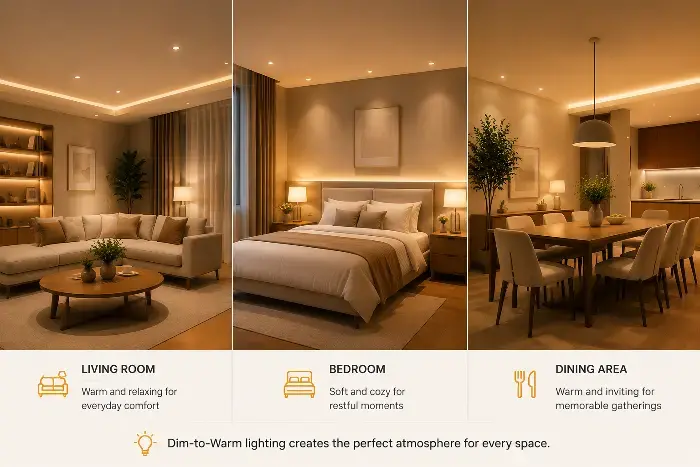
Hotels and hospitality environments rely heavily on lighting to shape guest experience across different time periods and usage scenarios.
غرف الضيوف
- Smooth transition from functional lighting to relaxation mode
- Supports winding-down behavior without switching fixtures
Lobbies
- Creates warm first impressions
- Enhances perceived luxury and brand identity
الممرات
- Soft low-glare navigation lighting
- Improved visual comfort and reduced harsh contrast
Restaurants and Bars
- Adaptive mood lighting for different service phases
- Enhances food presentation and social atmosphere
Dim-to-warm systems reduce the need for multiple fixtures with different CCTs, simplifying architectural lighting design.
Why Dim-to-Warm Works in Residential Spaces
Residential lighting requires flexibility across different times of day and human activities.
Living Rooms
- Bright neutral warm light for daytime use
- Softer warm tones for evening relaxation
غرف النوم
- Ultra-warm low-intensity lighting for pre-sleep comfort
- Supports relaxation-oriented environments
Dining Areas
- Adjustable ambiance for social or functional use
- Enhances material perception and food appearance
Dim-to-warm GU10 simplifies lighting control without requiring complex smart lighting infrastructure.
Why Metal GU10 Design Matters
Many professional dim-to-warm GU10 products use a metal cup optical and thermal structure, which provides both performance and reliability advantages.
1. إدارة الحرارة
Efficient heat dissipation helps:
- Stabilize LED junction temperature
- Maintain consistent chromaticity over time
- Extend system lifespan and lumen maintenance performance
2. Optical Control
Metal reflector structures improve:
- Beam accuracy and directionality
- Reduction of stray light
- Higher contrast accent lighting performance
3. Visual Comfort and Glare Control
Well-designed optical systems contribute to:
- Softer beam cut-off
- Improved visual comfort in architectural spaces
- More premium “lighting without glare” perception
Dim-to-Warm vs Fixed CCT GU10
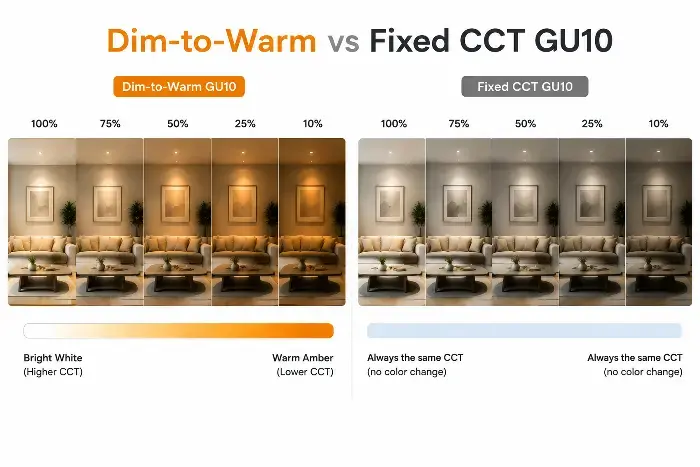
| ميزة | Fixed CCT GU10 | Dim-to-Warm GU10 |
|---|---|---|
| Color Temperature Behavior | Static | Dynamic shift |
| Dimming Output | Brightness only | Brightness + CCT change |
| Atmosphere Control | محدود | High flexibility |
| Design Application | Functional lighting | Experience-driven lighting |
| Architectural Value | أساسي | متميز |
Dim-to-warm lighting consolidates multiple lighting scenes into a single luminaire, significantly improving design efficiency.
Applications of Dim-to-Warm GU10 Lighting
Hospitality Sector
- Hotel guest rooms
- Suites and premium rooms
- Lobbies and reception areas
- Restaurants and lounges
Residential Sector
- غرف المعيشة
- غرف النوم
- Dining spaces
Commercial and Retail
- Boutique stores
- Jewelry lighting
- Luxury product displays
Entertainment Spaces
- Bars and lounges
- Mood-based environments
- Experience-driven venues
Engineering Insight: Why Quality Matters in Dim-to-Warm Systems
Not all dim-to-warm GU10 products deliver the same performance quality. High-performance systems require precise engineering in:
- Color rendering stability (CRI typically > 90, R9 optimized for premium environments)
- Smooth dimming curves without visible steps
- Flicker control (low flicker index / IEEE 1789-aligned design principles)
- Deep dimming capability (down to very low light levels)
- Controlled CCT shift linearity across dimming range
Low-quality implementations may result in:
- Color inconsistency at low brightness
- Noticeable flicker during dimming
- Abrupt or non-linear color transitions
Is Dim-to-Warm the Same as Human-Centric Lighting?
Dim-to-warm lighting is often associated with comfort-oriented lighting design, but it is not a full human-centric lighting system.
Human-Centric Lighting typically includes:
- Dynamic circadian tuning throughout the day
- Automated lighting control systems
- Biological rhythm optimization strategies
Dim-to-warm focuses on:
- Warm emotional transition during dimming
- Visual comfort and atmospheric control
- Evening relaxation and hospitality experience
Dim-to-warm can be part of a broader human-centric lighting strategy but does not replace it.
الأسئلة المتكررة
What is dim-to-warm lighting?
Dim-to-warm lighting is an LED technology where color temperature becomes warmer as brightness is reduced, simulating incandescent-like behavior.
Is dim-to-warm limited to a specific color temperature range?
No. Different products use different transition ranges such as 3000K→2200K, 2700K→1800K, or other engineered curves depending on application requirements.
Where is dim-to-warm lighting commonly used?
Hotels, restaurants, residential interiors, and high-end commercial environments.
Is dim-to-warm compatible with TRIAC dimmers?
Many professional GU10 dim-to-warm products support TRIAC (phase-cut) dimming systems, depending on driver design.
Why choose dim-to-warm over fixed CCT lighting?
It enables dynamic emotional lighting control within a single fixture, reducing design complexity and improving spatial experience.
الخلاصة
Dim-to-warm GU10 lighting represents a fundamental shift in architectural lighting design, moving from static illumination toward dynamic emotional control.
Rather than being defined by a single color temperature range, dim-to-warm technology is defined by its ability to create smooth, natural transitions in both brightness and color temperature simultaneously.
In hospitality environments, it enhances guest experience and spatial perception. In residential applications, it improves comfort and daily living quality. In commercial and architectural spaces, it enables more flexible and emotionally responsive lighting design.
As lighting continues to evolve toward experience-driven environments, dim-to-warm technology has become an essential tool for architects, designers, and lighting manufacturers.
Need Premium Dim-to-Warm GU10 Lighting Solutions for Your Project?
As an OEM/ODM lighting manufacturer, we support architectural and hospitality projects with engineered dim-to-warm solutions designed for performance, stability, and optical precision.
We offer:
- Flexible dim-to-warm CCT transition curves (various ranges available)
- High CRI options (CRI > 90 with optimized R9 performance)
- Metal cup optical structure for controlled beam performance
- Flicker-free, smooth deep dimming capability
- TRIAC / 0–10V / phase-cut compatibility options
Contact our engineering team to request:
- Free sample kit
- IES photometric files
- Technical datasheets
- Custom project consultation