Bluetooth Mesh vs. Zigbee: Welches Smart-Lighting-Protokoll schneidet besser ab?
Einführung: Das Konnektivitätsrennen im Smart Lighting
Der globale Smart-Lighting-Markt tritt in eine neue Ära der drahtlosen Steuerung ein. Von Bürogebäuden bis zu Gastronomie- und Hotelbereichen fordern Kunden nun vernetzte LED-Lösungen die Effizienz, Flexibilität und Datensichtbarkeit kombinieren. Zwei der führenden Konnektivitätstechnologien, die diesen Wandel ermöglichen, sind Bluetooth Mesh und Zigbee.
Beide Protokolle versorgen weltweit Millionen von Beleuchtungsanlagen — unterscheiden sich jedoch erheblich in Architektur, Skalierbarkeit, Latenz, Interoperabilität und Energieeffizienz. Für Hersteller und B2B-Einkäufer, die intelligente LED-Leuchten oder Leuchten auswählen, kann die Wahl des richtigen Protokolls nicht nur das Benutzererlebnis, sondern auch die langfristige Zuverlässigkeit und Integrationsfähigkeit des Systems bestimmen.
In diesem Artikel untersuchen wir Bluetooth Mesh vs. Zigbee im Detail — wie jedes funktioniert, wo jedes glänzt und wie man entscheidet, welches Protokoll am besten zu Ihrem nächsten Beleuchtungsprojekt passt.
Der Aufstieg der drahtlosen Lichtsteuerung
Beleuchtungssteuerungsnetzwerke haben sich im letzten Jahrzehnt rasch weiterentwickelt. Früher auf verkabelte DALI- oder 0–10-V-Systeme beschränkt, ermöglichen drahtlose Standards Installateuren nun, Netzwerke bereitstellen, skalieren und neu konfigurieren ohne neue Kabel zu verlegen.
Laut MarketsandMarkets, wird der Smart-Lighting-Markt erreichen 27,7 Milliarden US-Dollar bis 2026, angetrieben durch IoT-Übernahme und Energievorschriften (Quelle).
Drahtlose Mesh-Protokolle wie Zigbee, Bluetooth Mesh, und Thread haben sich durchgesetzt, weil sie:
- Aktivieren Knoten-zu-Knoten-Kommunikation (selbstheilende Netzwerke).
- Reduzieren Sie die Inbetriebnahmekomplexität.
- Bieten Energieeffizienz durch energieeffiziente Kommunikation.
- Unterstützen die Integration mit IoT- und Gebäudemanagementsystemen.
Wie Zigbee funktioniert
Zigbee ist ein energiesparsames drahtloses Mesh-Netzwerkprotokoll basierend auf dem IEEE 802.15.4 Standard. Es arbeitet hauptsächlich im 2,4-GHz-ISM-Band, obwohl regionale Sub-GHz-Versionen existieren.
Hauptmerkmale:
- Mesh-Topologie: Jedes Gerät (Lampe, Schalter, Sensor) kann Nachrichten weiterleiten und so Reichweite und Robustheit erhöhen.
- Koordinator-Architektur: Das Netzwerk verlässt sich auf einen zentralen “Koordinator” (Gateway oder Hub), um Geräte zu verwalten.
- Niedrige Datenrate: Typischerweise 250 kbps — ausreichend für Steuerbefehle, nicht für hochbandbreitige Daten.
- Interoperabilität: Wird in vielen Ökosystemen unterstützt (Philips Hue, IKEA TRÅDFRI, Amazon Echo usw.).
Die Zigbee Alliance — jetzt umbenannt in die Connectivity Standards Alliance (CSA) — unterhält Zertifizierungsprogramme zur Gewährleistung der Geräteinteroperabilität.
(CSA offizielle Website)
Wie Bluetooth Mesh funktioniert
Bluetooth Mesh baut auf der allgegenwärtigen Bluetooth Low Energy (BLE) Standard, erweitert ihn jedoch, um großflächige Mesh-Netzwerke. Eingeführt in 2017 von der Bluetooth SIG, es wurde speziell für Gebäudeautomation und Lichtsteuerung entwickelt.
Hauptmerkmale:
- Flooding-Mesh-Architektur: Nachrichten werden durch das Netzwerk gesendet, ohne auf einen zentralen Hub angewiesen zu sein.
- Standard-Bluetooth-Hardware: Funktioniert im selben 2,4-GHz-Band wie BLE.
- Direkte Smartphone-Inbetriebnahme: Geräte können über Standard-Bluetooth-Apps konfiguriert werden – kein Hub erforderlich.
- Latenz & Zuverlässigkeit: Niedrige Latenz-Kommunikation geeignet für reaktionsschnelle Lichtszenen.
(Bluetooth SIG Mesh-Übersicht)
Da Bluetooth bereits in fast jedem Smartphone und Tablet integriert ist, Inbetriebnahme, Wartung und Benutzersteuerung einfacher und kostengünstiger werden im Vergleich zu proprietären Gateways.
Technischer Vergleich: Bluetooth Mesh vs. Zigbee
| Merkmal | Bluetooth Mesh | Zigbee |
|---|---|---|
| Netzwerktyp | Flooding-Mesh (kein Koordinator) | Geroutetes Mesh mit Koordinator |
| Frequenzband | 2,4 GHz ISM | 2,4 GHz (global), Sub-GHz optional |
| Datenrate | Bis zu 1 Mbps (BLE 5.0) | 250 kbit/s |
| Reichweite (pro Hop) | ~30 m innen (erweiterbar über Relaisknoten) | ~20–100 m abhängig von Leistung und Antenne |
| Maximale Knoten pro Netzwerk | 32.000+ Knoten (theoretisch) | ~65.000 Knoten (theoretisch) |
| Latenz | Typischerweise 10–30 ms | Typischerweise 50–100 ms |
| Inbetriebnahme | Direkt über Smartphone (kein Hub) | Erfordert Gateway/Koordinator |
| Interoperabilität | Erfordert dasselben Herstellermodell (SIG-Profile) | Breites Ökosystem (CSA-Zertifizierung) |
| Sicherheit | AES-128-Verschlüsselung mit verwalteten Schlüsseln | AES-128, Link-Verschlüsselung |
| Energieeffizienz | Sehr hoch (optimiert für BLE 5.0) | Mäßig; hängt von der Routing-Last ab |
| Internetverbindung | Erfordert BLE-Wi-Fi-Bridge für Cloud | Gateway stellt Internetverbindung bereit |
| Typische Anwendungsfälle | Gewerbliche Beleuchtung, Einzelhandel, Smart Homes | Große gewerbliche Standorte, Industrieautomatisierung |
Quellen:
Leistungsanalyse

5.1 Latenz & Reaktionsfähigkeit
- Bluetooth Mesh bietet schnellere Szenenübergänge – oft unter 30 ms zwischen Befehl und Lichtreaktion, ideal für dynamische Lichtszenen.
- Zigbee, während etwas langsamer, bietet deterministisches Routing, besser für große Multi-Zonen-Installationen, bei denen vorhersehbare Zustellung wichtig ist.
5.2 Skalierbarkeit
Zigbee skaliert effizient in sehr großen Infrastrukturen (z.B. Lagerhäuser, Campusgelände) mit Routern und Koordinatoren. Bluetooth Mesh kann ebenfalls skalieren, erfordert jedoch möglicherweise eine sorgfältige Netzwerkplanung, um Nachrichtenfluten zu verwalten und Überlastung in Netzwerken mit >1.000 Knoten zu vermeiden.
5.3 Energieeffizienz
Beide sind für geringen Stromverbrauch ausgelegt. BLEs kurze Werbepakete bieten Bluetooth Mesh bis zu 15 % geringerer Stromverbrauch pro Nachricht im Vergleich zu Zigbee bei ähnlicher Last (Silicon Labs Testbericht 2023).
5.4 Zuverlässigkeit
Zigbees geroutete Topologie ist robust – wenn ein Router ausfällt, leiten andere Nachrichten automatisch um. Bluetooth Meshs Flooding-Ansatz bietet Redundanz, kann aber bei fehlender Verwaltung von Relay-Knoten-Limits höheren Overhead verursachen.
5.5 Interoperabilität
Zigbee hat dank seines großen Ökosystems die Nase vorn – große Marken (Signify, IKEA, Tuya, Schneider) zertifizieren nach demselben CSA-Standard.
Bluetooth Mesh-Geräte müssen dasselbe Von der SIG übernommene Modelldefinitionen, aber die Multi-Vendor-Kompatibilität verbessert sich. (Bluetooth SIG Update 2024)
Installation und Inbetriebnahme
Bluetooth Mesh
- Die Inbetriebnahme kann direkt über Smartphone mit herstellereigenen oder SIG-konformen Apps erfolgen.
- Keine dedizierten Hubs erforderlich, was reduziert die BOM-Kosten und vereinfacht die Einrichtung.
- Ideal für Nachrüstprojekte und kleine bis mittlere gewerbliche Räume.
Zigbee
- Erfordert ein Gateway (z.B. Philips Hue Bridge oder Tuya Hub) zur Verwaltung des Netzwerks.
- Besser geeignet für zentralisiertes Management großer Installationen über mehrere Stockwerke oder Gebäude hinweg.
- Die Inbetriebnahme erfordert typischerweise Integrationstools (z.B. Daintree ControlScope, Osram Lightify Pro).
Use-Case Comparison

| Anmeldung | Recommended Protocol | Grund |
|---|---|---|
| Small Retail or Hospitality | Bluetooth Mesh | Quick setup, smartphone control, low infrastructure cost |
| Large Commercial Offices | Zigbee | Stable routing, gateway management, integration with BMS |
| Industrial Facilities | Zigbee | High node count, robust network control |
| Smart Home Retrofit | Bluetooth Mesh | Works with phones and BLE switches |
| Outdoor / Street Lighting | Zigbee (or Thread) | Extended range, sub-GHz options |
| Retail Shelf Lighting / Display | Bluetooth Mesh | Fast response, local control, scene grouping |
Security and Maintenance
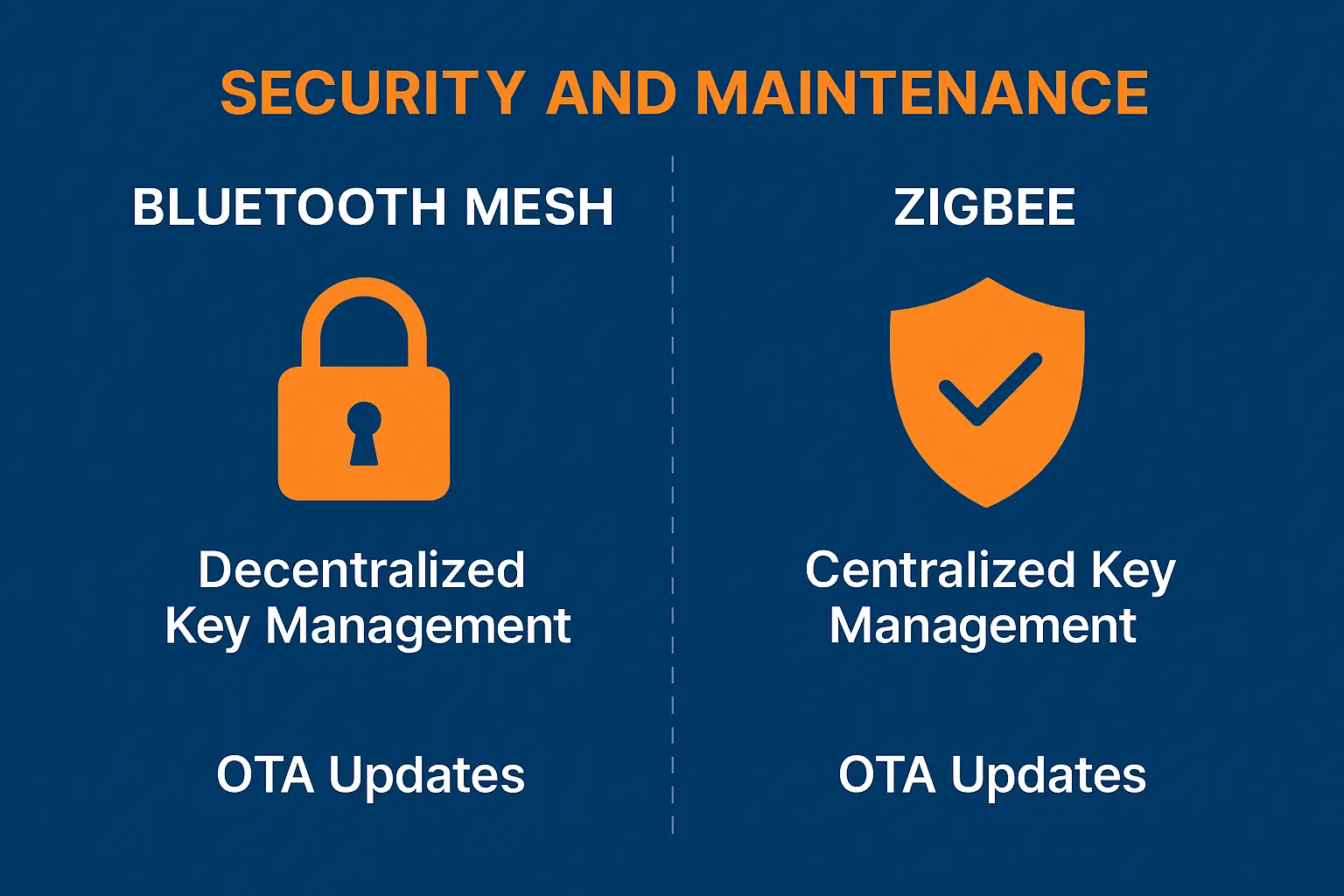
Both protocols use AES-128 encryption but differ in key distribution:
- Zigbee: Centralized key management by the coordinator. Ideal for enterprise environments but requires robust gateway security.
- Bluetooth Mesh: Decentralized key management — each device stores network and application keys locally. This reduces single-point-of-failure risks.
Firmware upgrades are increasingly supported over-the-air (OTA) by both systems. For example, Silicon Labs’ Bluetooth Mesh SDK allows firmware distribution to thousands of nodes simultaneously. (Silicon Labs OTA Docs)
Integration with IoT and Cloud Platforms
Zigbee
Because Zigbee typically connects via a hub, it integrates easily into cloud ecosystems such as Amazon Alexa, Google Home, und SmartThings. These gateways provide API access for large-scale remote management.
Bluetooth Mesh
BLE devices connect locally and use a BLE-Wi-Fi bridge oder Gateway for cloud functions. The advantage is that Bluetooth Mesh networks can still operate fully offline if the Internet link fails, maintaining local control.
Der Bluetooth SIG reports that 92 % of commercial Bluetooth Mesh lighting networks are used in “hybrid local-plus-cloud” configurations for reliability. (Bluetooth SIG 2023 Market Update)
Cost and Ecosystem Maturity

| Faktor | Bluetooth Mesh | Zigbee |
|---|---|---|
| Module Cost (approx.) | $1.80 – $3.50 per unit | $2.50 – $4.00 per unit |
| Gateway Requirement | Optional | Mandatory |
| Ecosystem Vendors | 200+ (CSR, Nordic, Silicon Labs, Tuya, etc.) | 500+ (Philips, Osram, Tuya, Schneider, etc.) |
| Software Stack Cost | Often royalty-free (SIG) | Licensed or embedded via OEM partners |
| Time-to-Market | Shorter (uses standard BLE hardware) | Longer (certification, gateway setup) |
Quellen:
For OEMs, Bluetooth Mesh can reduce hardware and certification costs while maintaining scalability for small- to mid-sized deployments. Zigbee remains dominant in enterprise and industrial lighting systems where management and integration depth outweigh component costs.
Real-World Examples

- Philips Hue (Zigbee): Over 100 million Zigbee-based bulbs deployed globally (Signify Annual Report 2023).
- Casambi (Bluetooth Mesh): European commercial lighting leader with over 1 million networks across retail and architectural projects (casambi.com).
- Tecolite Smart Series: Uses Bluetooth Mesh control for GU10 and MR16 LED bulbs to simplify commissioning without additional hubs.
Environmental and Energy Efficiency Implications
Efficient communication protocols directly impact overall system power draw.
- Bluetooth Mesh’s low packet overhead and sleep scheduling reduce control-network power consumption by up to 30 % in small installations.
- Zigbee’s routing overhead increases power slightly but remains efficient in large multi-hop networks.
As lighting accounts for nearly 15 % of global electricity use, adopting efficient wireless controls supports corporate sustainability goals. (IEA Lighting Efficiency Report 2022)
Which Protocol Performs Better Overall?
| Kategorie | Winner | Notizen |
|---|---|---|
| Ease of Deployment | Bluetooth Mesh | No hub, smartphone commissioning |
| Large-Scale Management | Zigbee | Better for enterprise networks |
| Latency / Response Time | Bluetooth Mesh | Faster scene transitions |
| Ecosystem Size | Zigbee | Established vendor base |
| Cost Efficiency | Bluetooth Mesh | Lower hardware & setup cost |
| Cloud Integration | Zigbee | Native via gateway APIs |
| Offline Operation | Bluetooth Mesh | Full control without Internet |
| Energieeffizienz | Bluetooth Mesh (slightly) | Lower packet overhead |
Verdict:
- For retrofit and small-to-medium commercial lighting, Bluetooth Mesh offers simpler deployment, lower cost, and faster control.
- For large multi-building or centralized enterprise networks, Zigbee remains the preferred choice for robust routing and system-wide management.
Future Outlook: Matter and Unified IoT Standards
Both Zigbee and Bluetooth Mesh are expected to coexist under the emerging Matter protocol (developed by the CSA). Matter uses IP-based communication and bridges existing ecosystems — including Zigbee and BLE — to provide seamless smart-home and commercial interoperability. (CSA Matter Overview)
Manufacturers investing today in BLE 5.0+ and Zigbee 3.0 hardware are already future-proofing their designs for Matter compatibility, ensuring long-term interoperability.
Conclusion: Making the Smart Choice
Both Bluetooth Mesh und Zigbee deliver reliable, efficient, and secure wireless control for LED lighting systems. The better option depends on your project size, network complexity, und user interface requirements.
For lighting manufacturers producing retrofit bulbs like GU10, MR16, or AR111, Bluetooth Mesh provides the most practical path to smart connectivity — fast setup, smartphone control, and hub-free deployment.
For large-scale B2B projects such as commercial campuses or industrial plants, Zigbee remains a trusted workhorse with mature management tools.
Ultimately, the most effective approach may be a hybrid model — combining both protocols under unified Matter or cloud frameworks, enabling maximum flexibility, scalability, and user satisfaction.
Whether you’re designing smart bulbs, retrofit modules, or connected lighting fixtures, understanding the differences between Bluetooth Mesh and Zigbee is key to building scalable and reliable solutions.
At Tecolite, we specialize in designing and manufacturing smart LED bulbs — including GU10, MR16, and AR111 models — that integrate seamlessly with both Bluetooth Mesh and Zigbee ecosystems.
Our engineering team helps OEM partners and distributors develop energy-efficient, standards-compliant products ready for Energy Label 2.0, Ecodesign, und Matter future compatibility.
Visit tecolite.com to explore our smart-lighting solutions or contact our sales team to discuss customized wireless control options for your next project.