Bluetooth Mesh vs. Zigbee: ¿Qué protocolo de iluminación inteligente funciona mejor?
Introducción: La carrera de conectividad en la iluminación inteligente
El mercado global de iluminación inteligente está entrando en una nueva era de control inalámbrico. Desde oficinas comerciales hasta espacios de hostelería, los clientes ahora exigen soluciones LED conectadas que combinan eficiencia, flexibilidad y visibilidad de datos. Dos de las principales tecnologías de conectividad que permiten esta transformación son Bluetooth Mesh y Zigbee.
Ambos protocolos alimentan millones de instalaciones de iluminación en todo el mundo, pero difieren significativamente en arquitectura, escalabilidad, latencia, interoperabilidad y rendimiento energético. Para fabricantes y compradores B2B que seleccionan bombillas LED inteligentes o luminarias, elegir el protocolo adecuado puede determinar no solo la experiencia del usuario, sino también la confiabilidad a largo plazo del sistema y su potencial de integración.
En este artículo, exploraremos Bluetooth Mesh vs. Zigbee en profundidad — cómo funciona cada uno, dónde sobresale cada uno y cómo decidir qué protocolo se adapta mejor a su próximo proyecto de iluminación.
El auge del control de iluminación inalámbrico
Las redes de control de iluminación han evolucionado rápidamente en la última década. Antes limitadas a sistemas cableados DALI o 0–10 V, los estándares inalámbricos ahora permiten a los instaladores desplegar, escalar y reconfigurar redes sin tender nuevos cables.
Según MarketsandMarkets, el mercado de iluminación inteligente alcanzará USD 27.700 millones para 2026, impulsado por Adopción de IoT y regulaciones energéticas (fuente).
Protocolos de malla inalámbrica como Zigbee, Bluetooth Mesh, y Thread se han vuelto dominantes porque:
- Habilitar comunicación de nodo a nodo (redes de autocuración).
- Reducir la complejidad de la puesta en marcha.
- Ofrecer eficiencia energética a través de comunicación de baja potencia.
- Soporte de integración con sistemas IoT y de gestión de edificios.
Cómo funciona Zigbee
Zigbee es un protocolo de red de malla inalámbrica de baja potencia basado en el IEEE 802.15.4 estándar. Opera principalmente en el banda ISM de 2,4 GHz, aunque existen versiones regionales por debajo de 1 GHz.
Características clave:
- Topología de malla: Cada dispositivo (luz, interruptor, sensor) puede retransmitir mensajes, extendiendo el alcance y la resistencia.
- Arquitectura de coordinador: La red depende de un “coordinador” central (puerta de enlace o concentrador) para gestionar los dispositivos.
- Baja tasa de datos: Típicamente 250 kbps — suficiente para comandos de control, no para datos de alto ancho de banda.
- Interoperabilidad: Ampliamente soportado en ecosistemas (Philips Hue, IKEA TRÅDFRI, Amazon Echo, etc.).
La Alianza Zigbee — ahora rebautizada como la Alianza de Estándares de Conectividad (CSA) — mantiene programas de certificación para garantizar la interoperabilidad de dispositivos.
(Sitio oficial de CSA)
Cómo Funciona Bluetooth Mesh
Bluetooth Mesh se basa en el omnipresente Bluetooth Low Energy (BLE) estándar pero lo extiende para crear redes de malla a gran escala. Introducido en 2017 por el Bluetooth SIG, fue diseñado específicamente para automatización de edificios y control de iluminación.
Características clave:
- Arquitectura de malla por inundación: Los mensajes se difunden a través de la red sin depender de un concentrador central.
- Hardware Bluetooth estándar: Funciona en la misma banda de 2.4 GHz utilizada por BLE.
- Puesta en marcha directa desde smartphone: Los dispositivos pueden configurarse mediante aplicaciones Bluetooth estándar — no se requiere concentrador.
- Latencia y fiabilidad: Comunicación de baja latencia adecuada para escenas de iluminación responsivas.
(Resumen de Bluetooth SIG Mesh)
Debido a que Bluetooth ya está integrado en casi todos los smartphones y tabletas, puesta en servicio, mantenimiento y control de usuario se vuelven más simples y rentables en comparación con puertas de enlace propietarias.
Comparación técnica: Bluetooth Mesh vs. Zigbee
| Característica | Bluetooth Mesh | Zigbee |
|---|---|---|
| Tipo de red | Malla por inundación (sin coordinador) | Malla enrutada con coordinador |
| Banda de frecuencia | 2.4 GHz ISM | 2,4 GHz (global), sub-GHz opcional |
| Tasa de Datos | Hasta 1 Mbps (BLE 5.0) | 250 kbps |
| Alcance (por salto) | ~30 m en interiores (ampliable mediante nodos de retransmisión) | ~20–100 m dependiendo de potencia y antena |
| Nodos Máximos por Red | 32.000+ nodos (teórico) | ~65.000 nodos (teórico) |
| Latencia | Normalmente 10–30 ms | Normalmente 50–100 ms |
| Puesta en servicio | Directo a través de smartphone (sin concentrador) | Requiere puerta de enlace/coordinador |
| Interoperabilidad | Requiere modelo del mismo fabricante (perfiles SIG) | Ecosistema amplio (certificación CSA) |
| Seguridad | Cifrado AES-128 con claves gestionadas | AES-128, cifrado a nivel de enlace |
| Power Efficiency | Very high (optimized for BLE 5.0) | Moderate; depends on routing load |
| Internet Connectivity | Requires BLE-Wi-Fi bridge for cloud | Gateway provides Internet link |
| Typical Use Cases | Commercial lighting, retail, smart homes | Large commercial sites, industrial automation |
Sources:
Performance Analysis

5.1 Latency & Responsiveness
- Bluetooth Mesh offers faster scene transitions — often under 30 ms between command and light response, ideal for dynamic lighting scenes.
- Zigbee, while slightly slower, provides deterministic routing, better for large multi-zone installations where predictable delivery matters.
5.2 Scalability
Zigbee scales efficiently in very large infrastructures (e.g., warehouses, campuses) using routers and coordinators. Bluetooth Mesh can also scale but may require careful network planning to manage message flooding and avoid congestion in >1,000-node networks.
5.3 Energy Efficiency
Both are designed for low power. BLE’s short advertising packets give Bluetooth Mesh up to 15 % lower power consumption per message vs. Zigbee at similar loads (Silicon Labs 2023 Test Report).
5.4 Reliability
Zigbee’s routed topology is resilient — if one router fails, others re-route messages automatically. Bluetooth Mesh’s flooding approach provides redundancy but can create higher overhead if not managed with relay-node limits.
5.5 Interoperability
Zigbee has the edge thanks to its large ecosystem — major brands (Signify, IKEA, Tuya, Schneider) certify under the same CSA standard.
Bluetooth Mesh devices must share the same SIG-adopted model definitions, but multi-vendor compatibility is improving. (Bluetooth SIG 2024 Update)
Installation and Commissioning
Bluetooth Mesh
- Commissioning can be done directly via smartphone using vendor or SIG-compliant apps.
- No need for dedicated hubs, which reduces BOM cost and simplifies setup.
- Ideal for retrofit projects and small-to-medium-sized commercial spaces.
Zigbee
- Requires a gateway (e.g., Philips Hue Bridge or Tuya Hub) to manage the network.
- Better suited for centralized management of large deployments across multiple floors or buildings.
- Commissioning typically requires integration tools (e.g., Daintree ControlScope, Osram Lightify Pro).
Use-Case Comparison

| Aplicación | Recommended Protocol | Razón |
|---|---|---|
| Small Retail or Hospitality | Bluetooth Mesh | Quick setup, smartphone control, low infrastructure cost |
| Large Commercial Offices | Zigbee | Stable routing, gateway management, integration with BMS |
| Industrial Facilities | Zigbee | High node count, robust network control |
| Smart Home Retrofit | Bluetooth Mesh | Works with phones and BLE switches |
| Outdoor / Street Lighting | Zigbee (or Thread) | Extended range, sub-GHz options |
| Retail Shelf Lighting / Display | Bluetooth Mesh | Fast response, local control, scene grouping |
Security and Maintenance
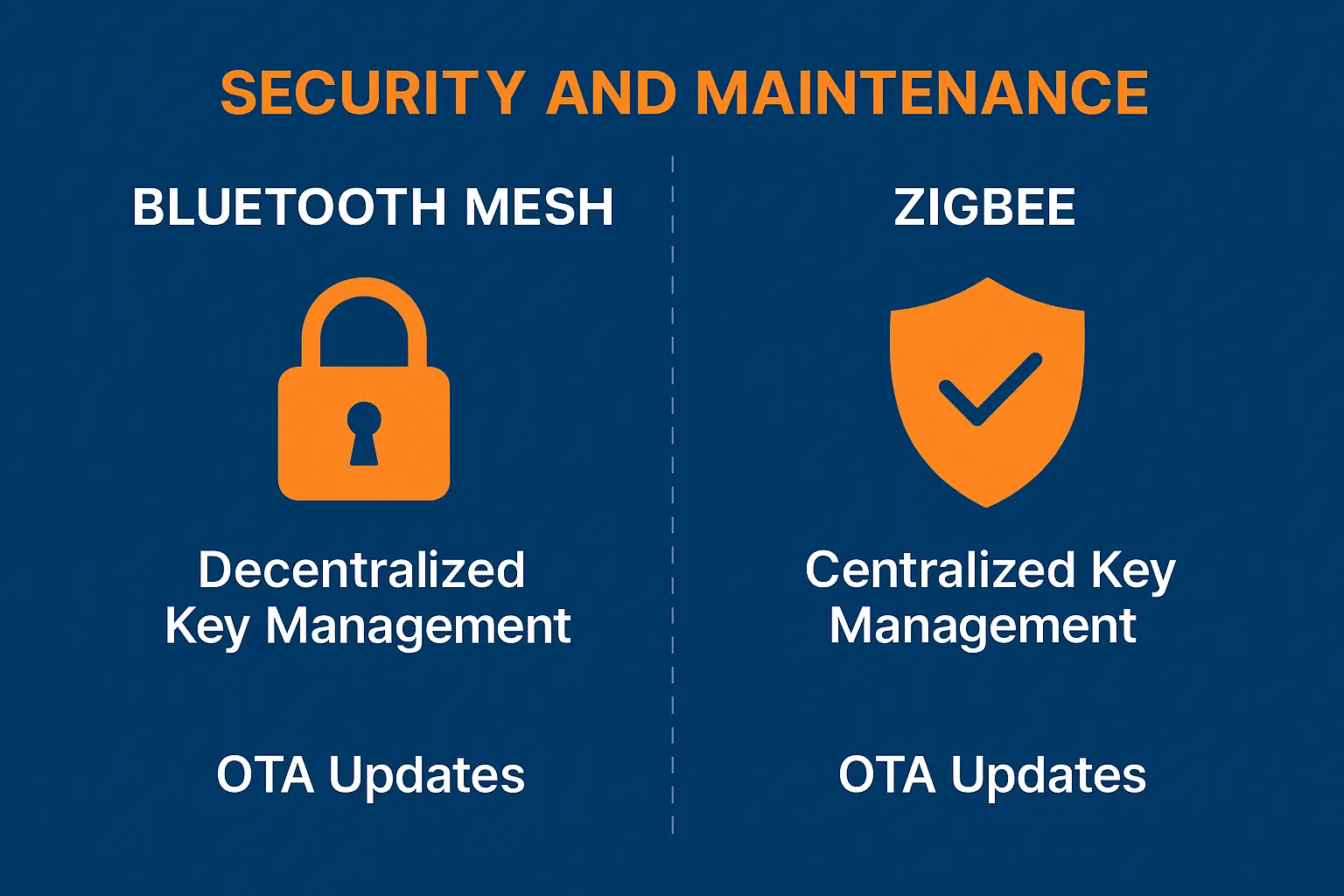
Both protocols use AES-128 encryption but differ in key distribution:
- Zigbee: Centralized key management by the coordinator. Ideal for enterprise environments but requires robust gateway security.
- Bluetooth Mesh: Decentralized key management — each device stores network and application keys locally. This reduces single-point-of-failure risks.
Firmware upgrades are increasingly supported over-the-air (OTA) by both systems. For example, Silicon Labs’ Bluetooth Mesh SDK allows firmware distribution to thousands of nodes simultaneously. (Silicon Labs OTA Docs)
Integration with IoT and Cloud Platforms
Zigbee
Because Zigbee typically connects via a hub, it integrates easily into cloud ecosystems such as Amazon Alexa, Google Home, y SmartThings. These gateways provide API access for large-scale remote management.
Bluetooth Mesh
BLE devices connect locally and use a BLE-Wi-Fi bridge o gateway for cloud functions. The advantage is that Bluetooth Mesh networks can still operate fully offline if the Internet link fails, maintaining local control.
El Bluetooth SIG reports that 92 % of commercial Bluetooth Mesh lighting networks are used in “hybrid local-plus-cloud” configurations for reliability. (Bluetooth SIG 2023 Market Update)
Cost and Ecosystem Maturity

| Factor | Bluetooth Mesh | Zigbee |
|---|---|---|
| Module Cost (approx.) | $1.80 – $3.50 per unit | $2.50 – $4.00 per unit |
| Gateway Requirement | Opcional | Obligatorio |
| Ecosystem Vendors | 200+ (CSR, Nordic, Silicon Labs, Tuya, etc.) | 500+ (Philips, Osram, Tuya, Schneider, etc.) |
| Software Stack Cost | Often royalty-free (SIG) | Licensed or embedded via OEM partners |
| Time-to-Market | Shorter (uses standard BLE hardware) | Longer (certification, gateway setup) |
Sources:
For OEMs, Bluetooth Mesh can reduce hardware and certification costs while maintaining scalability for small- to mid-sized deployments. Zigbee remains dominant in enterprise and industrial lighting systems where management and integration depth outweigh component costs.
Real-World Examples

- Philips Hue (Zigbee): Over 100 million Zigbee-based bulbs deployed globally (Signify Annual Report 2023).
- Casambi (Bluetooth Mesh): European commercial lighting leader with over 1 million networks across retail and architectural projects (casambi.com).
- Tecolite Smart Series: Uses Bluetooth Mesh control for GU10 and MR16 LED bulbs to simplify commissioning without additional hubs.
Environmental and Energy Efficiency Implications
Efficient communication protocols directly impact overall system power draw.
- Bluetooth Mesh’s low packet overhead and sleep scheduling reduce control-network power consumption by up to 30 % in small installations.
- Zigbee’s routing overhead increases power slightly but remains efficient in large multi-hop networks.
As lighting accounts for nearly 15 % of global electricity use, adopting efficient wireless controls supports corporate sustainability goals. (IEA Lighting Efficiency Report 2022)
Which Protocol Performs Better Overall?
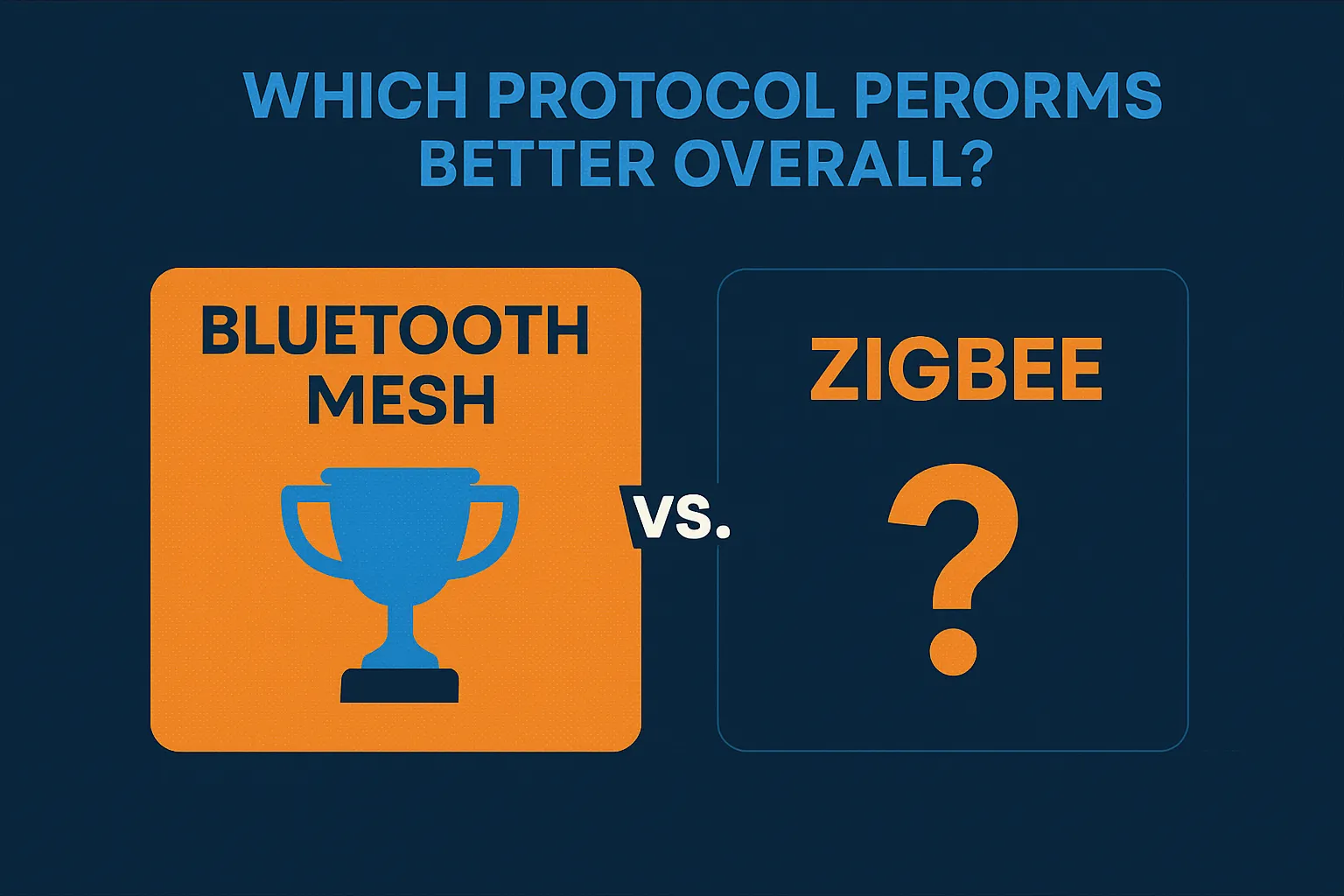
| Categoría | Winner | Notas |
|---|---|---|
| Ease of Deployment | Bluetooth Mesh | No hub, smartphone commissioning |
| Large-Scale Management | Zigbee | Better for enterprise networks |
| Latency / Response Time | Bluetooth Mesh | Faster scene transitions |
| Ecosystem Size | Zigbee | Established vendor base |
| Cost Efficiency | Bluetooth Mesh | Lower hardware & setup cost |
| Cloud Integration | Zigbee | Native via gateway APIs |
| Offline Operation | Bluetooth Mesh | Full control without Internet |
| Eficiencia energética | Bluetooth Mesh (slightly) | Lower packet overhead |
Verdict:
- For retrofit and small-to-medium commercial lighting, Bluetooth Mesh offers simpler deployment, lower cost, and faster control.
- For large multi-building or centralized enterprise networks, Zigbee remains the preferred choice for robust routing and system-wide management.
Future Outlook: Matter and Unified IoT Standards
Both Zigbee and Bluetooth Mesh are expected to coexist under the emerging Matter protocol (developed by the CSA). Matter uses IP-based communication and bridges existing ecosystems — including Zigbee and BLE — to provide seamless smart-home and commercial interoperability. (CSA Matter Overview)
Manufacturers investing today in BLE 5.0+ and Zigbee 3.0 hardware are already future-proofing their designs for Matter compatibility, ensuring long-term interoperability.
Conclusion: Making the Smart Choice
Both Bluetooth Mesh y Zigbee deliver reliable, efficient, and secure wireless control for LED lighting systems. The better option depends on your project size, network complexity, y user interface requirements.
For lighting manufacturers producing retrofit bulbs like GU10, MR16, or AR111, Bluetooth Mesh provides the most practical path to smart connectivity — fast setup, smartphone control, and hub-free deployment.
For large-scale B2B projects such as commercial campuses or industrial plants, Zigbee remains a trusted workhorse with mature management tools.
Ultimately, the most effective approach may be a hybrid model — combining both protocols under unified Matter or cloud frameworks, enabling maximum flexibility, scalability, and user satisfaction.
Whether you’re designing smart bulbs, retrofit modules, or connected lighting fixtures, understanding the differences between Bluetooth Mesh and Zigbee is key to building scalable and reliable solutions.
At Tecolite, we specialize in designing and manufacturing smart LED bulbs — including GU10, MR16, and AR111 models — that integrate seamlessly with both Bluetooth Mesh and Zigbee ecosystems.
Our engineering team helps OEM partners and distributors develop energy-efficient, standards-compliant products ready for Energy Label 2.0, Ecodesign, y Matter future compatibility.
Visit tecolite.com to explore our smart-lighting solutions or contact our sales team to discuss customized wireless control options for your next project.