Bluetooth Mesh contre Zigbee : quel protocole d'éclairage intelligent offre les meilleures performances ?
Introduction : La course à la connectivité dans l'éclairage intelligent
Le marché mondial de l'éclairage intelligent entre dans une nouvelle ère de contrôle sans fil. Des bureaux commerciaux aux espaces hôteliers, les clients exigent désormais solutions LED connectées qui combinent efficacité, flexibilité et visibilité des données. Deux des principales technologies de connectivité permettant cette transformation sont Bluetooth Mesh et Zigbee.
Les deux protocoles alimentent des millions d'installations d'éclairage dans le monde — pourtant ils diffèrent considérablement en architecture, évolutivité, latence, interopérabilité et performance énergétique. Pour les fabricants et les acheteurs B2B choisissant des ampoules LED intelligentes ou des luminaires, choisir le bon protocole peut déterminer non seulement l'expérience utilisateur, mais aussi la fiabilité à long terme du système et son potentiel d'intégration.
Dans cet article, nous explorerons Bluetooth Mesh contre Zigbee en profondeur — comment chacun fonctionne, où chacun excelle, et comment décider quel protocole convient le mieux à votre prochain projet d'éclairage.
L'essor du contrôle d'éclairage sans fil
Les réseaux de contrôle d'éclairage ont évolué rapidement au cours de la dernière décennie. Autrefois limités aux systèmes DALI filaires ou 0-10 V, les standards sans fil permettent désormais aux installateurs de déployer, mettre à l'échelle et reconfigurer les réseaux sans tirer de nouveaux câbles.
Selon MarketsandMarkets, le marché de l'éclairage intelligent atteindra 27,7 milliards USD d'ici 2026, entraîné par Adoption de l'IoT et réglementations énergétiques (source).
Les protocoles maillés sans fil comme Zigbee, Bluetooth Meshet Thread sont devenus dominants car ils :
- Permettre communication de nœud à nœud (réseaux auto-guérisseurs).
- Réduire la complexité de la mise en service.
- Offrir l'efficacité énergétique via une communication basse consommation.
- Prend en charge l'intégration avec les systèmes IoT et de gestion de bâtiment.
Comment fonctionne Zigbee
Zigbee est un protocole de réseau maillé sans fil à faible consommation basé sur le IEEE 802.15.4 standard. Il fonctionne principalement dans la bande ISM 2,4 GHz, bien qu'il existe des versions régionales sub-GHz.
Caractéristiques clés :
- Topologie maillée : Chaque appareil (lumière, interrupteur, capteur) peut relayer les messages, étendant la portée et la résilience.
- Architecture coordinateur : Le réseau repose sur un “ coordinateur ” central (passerelle ou hub) pour gérer les appareils.
- Faible débit de données : Typiquement 250 kbps — suffisant pour les commandes de contrôle, pas pour les données à haut débit.
- Interopérabilité : Large prise en charge dans les écosystèmes (Philips Hue, IKEA TRÅDFRI, Amazon Echo, etc.).
The Zigbee Alliance — now rebranded as the Connectivity Standards Alliance (CSA) — maintains certification programs to ensure device interoperability.
(CSA official site)
How Bluetooth Mesh Works
Bluetooth Mesh builds on the ubiquitous Bluetooth Low Energy (BLE) standard but extends it to create large-scale mesh networks. Introduced in 2017 by the Bluetooth SIG, it was designed specifically for building automation and lighting control.
Caractéristiques clés :
- Flooding mesh architecture: Messages are broadcast through the network without relying on a central hub.
- Standard Bluetooth hardware: Works on the same 2.4 GHz band used by BLE.
- Direct smartphone commissioning: Devices can be configured via standard Bluetooth apps — no hub required.
- Latency & reliability: Low-latency communication suitable for responsive lighting scenes.
(Bluetooth SIG Mesh Overview)
Because Bluetooth is already built into almost every smartphone and tablet, commissioning, maintenance, and user control become simpler and more cost-effective compared to proprietary gateways.
Technical Comparison: Bluetooth Mesh vs. Zigbee
| Fonctionnalité | Bluetooth Mesh | Zigbee |
|---|---|---|
| Network Type | Flooding mesh (no coordinator) | Routed mesh with coordinator |
| Frequency Band | 2.4 GHz ISM | 2.4 GHz (global), sub-GHz optional |
| Data Rate | Up to 1 Mbps (BLE 5.0) | 250 kbps |
| Range (per hop) | ~30 m indoors (extendable via relay nodes) | ~20–100 m depending on power and antenna |
| Max Nodes per Network | 32,000+ nodes (theoretical) | ~65,000 nodes (theoretical) |
| Latency | Typically 10–30 ms | Typically 50–100 ms |
| Commissioning | Direct via smartphone (no hub) | Requires gateway/coordinator |
| Interoperability | Requires same vendor model (SIG profiles) | Broad ecosystem (CSA certification) |
| Sécurité | AES-128 encryption with managed keys | AES-128, link-level encryption |
| Power Efficiency | Very high (optimized for BLE 5.0) | Moderate; depends on routing load |
| Internet Connectivity | Requires BLE-Wi-Fi bridge for cloud | Gateway provides Internet link |
| Typical Use Cases | Commercial lighting, retail, smart homes | Large commercial sites, industrial automation |
Sources:
Performance Analysis

5.1 Latency & Responsiveness
- Bluetooth Mesh offers faster scene transitions — often under 30 ms between command and light response, ideal for dynamic lighting scenes.
- Zigbee, while slightly slower, provides deterministic routing, better for large multi-zone installations where predictable delivery matters.
5.2 Scalability
Zigbee scales efficiently in very large infrastructures (e.g., warehouses, campuses) using routers and coordinators. Bluetooth Mesh can also scale but may require careful network planning to manage message flooding and avoid congestion in >1,000-node networks.
5.3 Energy Efficiency
Both are designed for low power. BLE’s short advertising packets give Bluetooth Mesh up to 15 % lower power consumption per message vs. Zigbee at similar loads (Silicon Labs 2023 Test Report).
5.4 Reliability
Zigbee’s routed topology is resilient — if one router fails, others re-route messages automatically. Bluetooth Mesh’s flooding approach provides redundancy but can create higher overhead if not managed with relay-node limits.
5.5 Interoperability
Zigbee has the edge thanks to its large ecosystem — major brands (Signify, IKEA, Tuya, Schneider) certify under the same CSA standard.
Bluetooth Mesh devices must share the same SIG-adopted model definitions, but multi-vendor compatibility is improving. (Bluetooth SIG 2024 Update)
Installation and Commissioning
Bluetooth Mesh
- Commissioning can be done directly via smartphone using vendor or SIG-compliant apps.
- No need for dedicated hubs, which reduces BOM cost and simplifies setup.
- Ideal for retrofit projects and small-to-medium-sized commercial spaces.
Zigbee
- Requires a gateway (e.g., Philips Hue Bridge or Tuya Hub) to manage the network.
- Better suited for centralized management of large deployments across multiple floors or buildings.
- Commissioning typically requires integration tools (e.g., Daintree ControlScope, Osram Lightify Pro).
Use-Case Comparison

| Application | Recommended Protocol | Raison |
|---|---|---|
| Small Retail or Hospitality | Bluetooth Mesh | Quick setup, smartphone control, low infrastructure cost |
| Large Commercial Offices | Zigbee | Stable routing, gateway management, integration with BMS |
| Industrial Facilities | Zigbee | High node count, robust network control |
| Smart Home Retrofit | Bluetooth Mesh | Works with phones and BLE switches |
| Outdoor / Street Lighting | Zigbee (or Thread) | Extended range, sub-GHz options |
| Retail Shelf Lighting / Display | Bluetooth Mesh | Fast response, local control, scene grouping |
Security and Maintenance
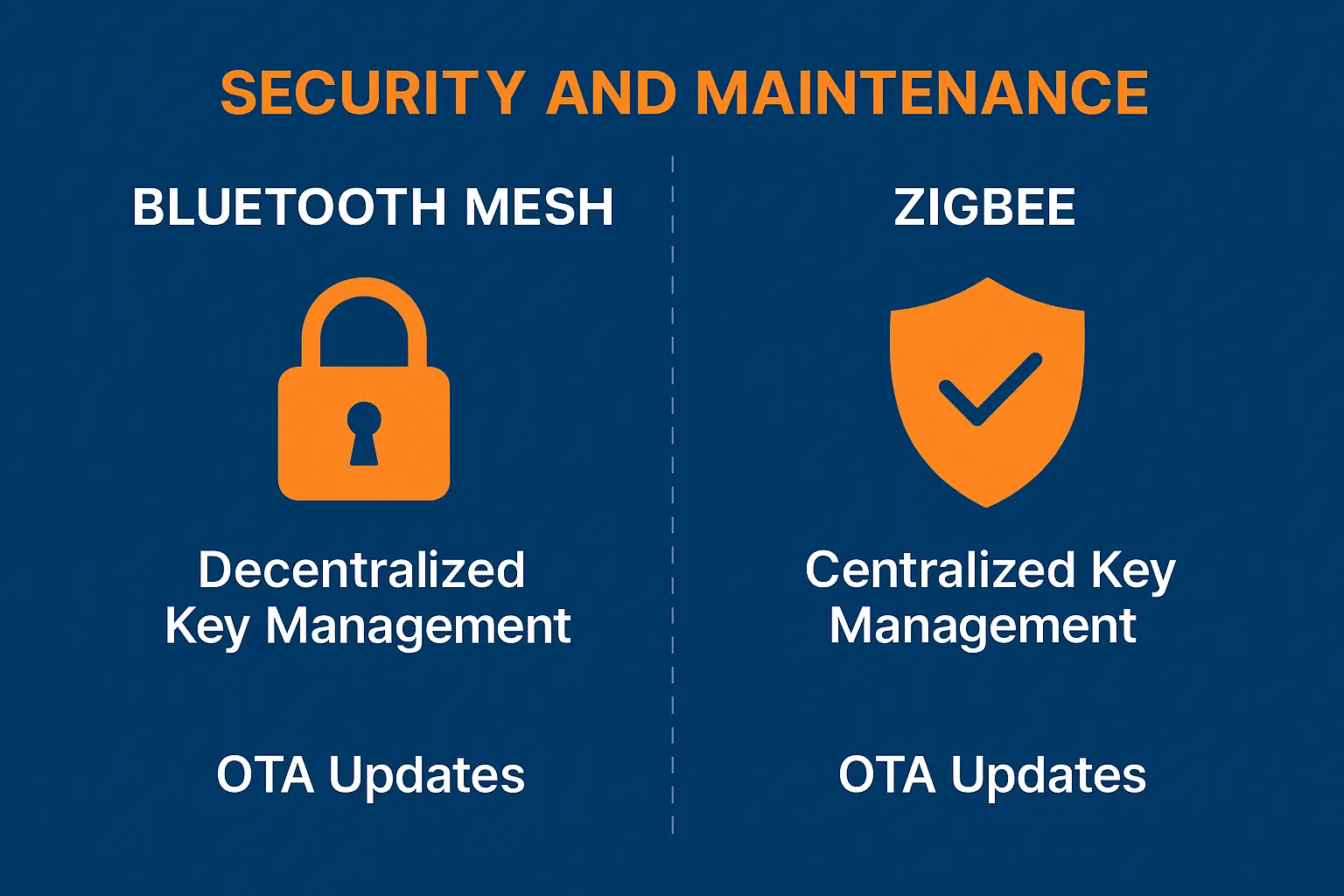
Both protocols use AES-128 encryption but differ in key distribution:
- Zigbee: Centralized key management by the coordinator. Ideal for enterprise environments but requires robust gateway security.
- Bluetooth Mesh: Decentralized key management — each device stores network and application keys locally. This reduces single-point-of-failure risks.
Firmware upgrades are increasingly supported over-the-air (OTA) by both systems. For example, Silicon Labs’ Bluetooth Mesh SDK allows firmware distribution to thousands of nodes simultaneously. (Silicon Labs OTA Docs)
Integration with IoT and Cloud Platforms
Zigbee
Because Zigbee typically connects via a hub, it integrates easily into cloud ecosystems such as Amazon Alexa, Google Homeet SmartThings. These gateways provide API access for large-scale remote management.
Bluetooth Mesh
BLE devices connect locally and use a BLE-Wi-Fi bridge ou gateway for cloud functions. The advantage is that Bluetooth Mesh networks can still operate fully offline if the Internet link fails, maintaining local control.
Le Bluetooth SIG reports that 92 % of commercial Bluetooth Mesh lighting networks are used in “hybrid local-plus-cloud” configurations for reliability. (Bluetooth SIG 2023 Market Update)
Cost and Ecosystem Maturity

| Facteur | Bluetooth Mesh | Zigbee |
|---|---|---|
| Module Cost (approx.) | $1.80 – $3.50 per unit | $2.50 – $4.00 per unit |
| Gateway Requirement | Optionnel | Obligatoire |
| Ecosystem Vendors | 200+ (CSR, Nordic, Silicon Labs, Tuya, etc.) | 500+ (Philips, Osram, Tuya, Schneider, etc.) |
| Software Stack Cost | Often royalty-free (SIG) | Licensed or embedded via OEM partners |
| Time-to-Market | Shorter (uses standard BLE hardware) | Longer (certification, gateway setup) |
Sources:
For OEMs, Bluetooth Mesh can reduce hardware and certification costs while maintaining scalability for small- to mid-sized deployments. Zigbee remains dominant in enterprise and industrial lighting systems where management and integration depth outweigh component costs.
Real-World Examples

- Philips Hue (Zigbee): Over 100 million Zigbee-based bulbs deployed globally (Signify Annual Report 2023).
- Casambi (Bluetooth Mesh): European commercial lighting leader with over 1 million networks across retail and architectural projects (casambi.com).
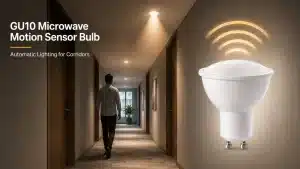
- Tecolite Smart Series: Uses Bluetooth Mesh control for GU10 and MR16 LED bulbs to simplify commissioning without additional hubs.
Environmental and Energy Efficiency Implications
Efficient communication protocols directly impact overall system power draw.
- Bluetooth Mesh’s low packet overhead and sleep scheduling reduce control-network power consumption by up to 30 % in small installations.
- Zigbee’s routing overhead increases power slightly but remains efficient in large multi-hop networks.
As lighting accounts for nearly 15 % of global electricity use, adopting efficient wireless controls supports corporate sustainability goals. (IEA Lighting Efficiency Report 2022)
Which Protocol Performs Better Overall?
| Catégorie | Winner | Notes |
|---|---|---|
| Ease of Deployment | Bluetooth Mesh | No hub, smartphone commissioning |
| Large-Scale Management | Zigbee | Better for enterprise networks |
| Latency / Response Time | Bluetooth Mesh | Faster scene transitions |
| Ecosystem Size | Zigbee | Established vendor base |
| Rapport coût-efficacité | Bluetooth Mesh | Lower hardware & setup cost |
| Cloud Integration | Zigbee | Native via gateway APIs |
| Offline Operation | Bluetooth Mesh | Full control without Internet |
| Efficacité énergétique | Bluetooth Mesh (slightly) | Lower packet overhead |
Verdict:
- Pour retrofit and small-to-medium commercial lighting, Bluetooth Mesh offers simpler deployment, lower cost, and faster control.
- Pour large multi-building or centralized enterprise networks, Zigbee remains the preferred choice for robust routing and system-wide management.
Future Outlook: Matter and Unified IoT Standards
Both Zigbee and Bluetooth Mesh are expected to coexist under the emerging Matter protocol (developed by the CSA). Matter uses IP-based communication and bridges existing ecosystems — including Zigbee and BLE — to provide seamless smart-home and commercial interoperability. (CSA Matter Overview)
Manufacturers investing today in BLE 5.0+ and Zigbee 3.0 hardware are already future-proofing their designs for Matter compatibility, ensuring long-term interoperability.
Conclusion: Making the Smart Choice
Les deux Bluetooth Mesh et Zigbee deliver reliable, efficient, and secure wireless control for LED lighting systems. The better option depends on your project size, network complexityet user interface requirements.
Pour lighting manufacturers producing retrofit bulbs like GU10, MR16, or AR111, Bluetooth Mesh provides the most practical path to smart connectivity — fast setup, smartphone control, and hub-free deployment.
Pour large-scale B2B projects such as commercial campuses or industrial plants, Zigbee remains a trusted workhorse with mature management tools.
Ultimately, the most effective approach may be a hybrid model — combining both protocols under unified Matter or cloud frameworks, enabling maximum flexibility, scalability, and user satisfaction.
Whether you’re designing smart bulbs, retrofit modules, or connected lighting fixtures, understanding the differences between Bluetooth Mesh and Zigbee is key to building scalable and reliable solutions.
At Tecolite, we specialize in designing and manufacturing smart LED bulbs — including GU10, MR16, and AR111 models — that integrate seamlessly with both Bluetooth Mesh and Zigbee ecosystems.
Our engineering team helps OEM partners and distributors develop energy-efficient, standards-compliant products ready for Energy Label 2.0, Ecodesignet Matter future compatibility.
Visit tecolite.com to explore our smart-lighting solutions or contact our sales team to discuss customized wireless control options for your next project.