Bluetooth Mesh対Zigbee: スマート照明プロトコルはどちらが優れているか?
はじめに:スマート照明における接続性競争
グローバルなスマート照明市場は、ワイヤレス制御の新時代に入っています。商業オフィスからホスピタリティ空間まで、クライアントは現在、 接続されたLEDソリューション 効率性、柔軟性、データ可視性を兼ね備えた。この変革を可能にする主要な接続技術の2つは Bluetoothメッシュ そして Zigbee.
両プロトコルは世界中の数百万の照明設備を支えていますが、以下の点で大きく異なります アーキテクチャ、スケーラビリティ、レイテンシ、相互運用性、エネルギー性能. 。スマートLED電球や照明器具を選択するメーカーやB2Bバイヤーにとって、適切なプロトコルの選択は、ユーザー体験だけでなく、システムの長期的な信頼性と統合可能性も決定します。.
この記事では、 Bluetoothメッシュ vs. Zigbee 詳細 — 各プロトコルの仕組み、得意分野、そして次の照明プロジェクトに最適なプロトコルの選び方。.
ワイヤレス照明制御の台頭
照明制御ネットワークは過去10年間で急速に進化しました。かつては有線のDALIや0–10 Vシステムに限定されていましたが、現在の無線規格により、設置者は ネットワークの展開、スケーリング、再構成 新たなケーブル配線なしで。.
に従って MarketsandMarkets, 、スマート照明市場は 2026年までに277億米ドル, 、駆動元: IoT導入とエネルギー規制 (ソース).
無線メッシュプロトコル、例えば Zigbee, Bluetoothメッシュ, 、および Thread が主流となった理由:
- 有効化する ノード間通信 (自己修復ネットワーク)。.
- 導入時の複雑さを軽減。.
- 提供する エネルギー効率 低電力通信を通じて。.
- IoTおよびビル管理システムとの統合をサポート。.
Zigbeeの仕組み
Zigbee は 低電力ワイヤレスメッシュネットワークプロトコル に基づく IEEE 802.15.4 標準。主に 2.4 GHz ISMバンド, 、ただし地域ごとのサブGHzバージョンも存在します。.
主な特徴:
- メッシュトポロジー: 各デバイス(照明、スイッチ、センサー)がメッセージを中継でき、通信範囲と耐障害性を拡張。.
- コーディネーターアーキテクチャ: ネットワークは、デバイスを管理する中央の「コーディネーター」(ゲートウェイまたはハブ)に依存しています。.
- 低データレート: 通常250 kbps — 制御コマンドには十分ですが、高帯域幅データには不十分です。.
- 相互運用性: 幅広いエコシステムでサポート(Philips Hue、IKEA TRÅDFRI、Amazon Echoなど)。.
Zigbee Alliance — 現在は Connectivity Standards Alliance (CSA) — maintains certification programs to ensure device interoperability.
(CSA official site)
How Bluetooth Mesh Works
Bluetoothメッシュ builds on the ubiquitous Bluetooth Low Energy (BLE) standard but extends it to create large-scale mesh networks. Introduced in 2017 by the Bluetooth SIG, it was designed specifically for building automation and lighting control.
主な特徴:
- Flooding mesh architecture: Messages are broadcast through the network without relying on a central hub.
- Standard Bluetooth hardware: Works on the same 2.4 GHz band used by BLE.
- Direct smartphone commissioning: Devices can be configured via standard Bluetooth apps — no hub required.
- Latency & reliability: Low-latency communication suitable for responsive lighting scenes.
(Bluetooth SIG Mesh Overview)
Because Bluetooth is already built into almost every smartphone and tablet, commissioning, maintenance, and user control become simpler and more cost-effective compared to proprietary gateways.
Technical Comparison: Bluetooth Mesh vs. Zigbee
| 特徴 | Bluetoothメッシュ | Zigbee |
|---|---|---|
| Network Type | Flooding mesh (no coordinator) | Routed mesh with coordinator |
| Frequency Band | 2.4 GHz ISM | 2.4 GHz (global), sub-GHz optional |
| Data Rate | Up to 1 Mbps (BLE 5.0) | 250 kbps |
| Range (per hop) | ~30 m indoors (extendable via relay nodes) | ~20–100 m depending on power and antenna |
| Max Nodes per Network | 32,000+ nodes (theoretical) | ~65,000 nodes (theoretical) |
| Latency | Typically 10–30 ms | Typically 50–100 ms |
| Commissioning | Direct via smartphone (no hub) | Requires gateway/coordinator |
| Interoperability | Requires same vendor model (SIG profiles) | Broad ecosystem (CSA certification) |
| Security | AES-128 encryption with managed keys | AES-128, link-level encryption |
| Power Efficiency | Very high (optimized for BLE 5.0) | Moderate; depends on routing load |
| Internet Connectivity | Requires BLE-Wi-Fi bridge for cloud | Gateway provides Internet link |
| Typical Use Cases | Commercial lighting, retail, smart homes | Large commercial sites, industrial automation |
Sources:
Performance Analysis

5.1 Latency & Responsiveness
- Bluetoothメッシュ offers faster scene transitions — often under 30 ms between command and light response, ideal for dynamic lighting scenes.
- Zigbee, while slightly slower, provides deterministic routing, better for large multi-zone installations where predictable delivery matters.
5.2 Scalability
Zigbee scales efficiently in very large infrastructures (e.g., warehouses, campuses) using routers and coordinators. Bluetooth Mesh can also scale but may require careful network planning to manage message flooding and avoid congestion in >1,000-node networks.
5.3 Energy Efficiency
Both are designed for low power. BLE’s short advertising packets give Bluetooth Mesh up to 15 % lower power consumption per message vs. Zigbee at similar loads (Silicon Labs 2023 Test Report).
5.4 Reliability
Zigbee’s routed topology is resilient — if one router fails, others re-route messages automatically. Bluetooth Mesh’s flooding approach provides redundancy but can create higher overhead if not managed with relay-node limits.
5.5 Interoperability
Zigbee has the edge thanks to its large ecosystem — major brands (Signify, IKEA, Tuya, Schneider) certify under the same CSA standard.
Bluetooth Mesh devices must share the same SIG-adopted model definitions, but multi-vendor compatibility is improving. (Bluetooth SIG 2024 Update)
Installation and Commissioning
Bluetoothメッシュ
- Commissioning can be done directly via smartphone using vendor or SIG-compliant apps.
- No need for dedicated hubs, which reduces BOM cost and simplifies setup.
- Ideal for retrofit projects and small-to-medium-sized commercial spaces.
Zigbee
- Requires a gateway (e.g., Philips Hue Bridge or Tuya Hub) to manage the network.
- Better suited for centralized management of large deployments across multiple floors or buildings.
- Commissioning typically requires integration tools (e.g., Daintree ControlScope, Osram Lightify Pro).
Use-Case Comparison

| 申し込み | Recommended Protocol | Reason |
|---|---|---|
| Small Retail or Hospitality | Bluetoothメッシュ | Quick setup, smartphone control, low infrastructure cost |
| Large Commercial Offices | Zigbee | Stable routing, gateway management, integration with BMS |
| Industrial Facilities | Zigbee | High node count, robust network control |
| Smart Home Retrofit | Bluetoothメッシュ | Works with phones and BLE switches |
| Outdoor / Street Lighting | Zigbee (or Thread) | Extended range, sub-GHz options |
| Retail Shelf Lighting / Display | Bluetoothメッシュ | Fast response, local control, scene grouping |
Security and Maintenance
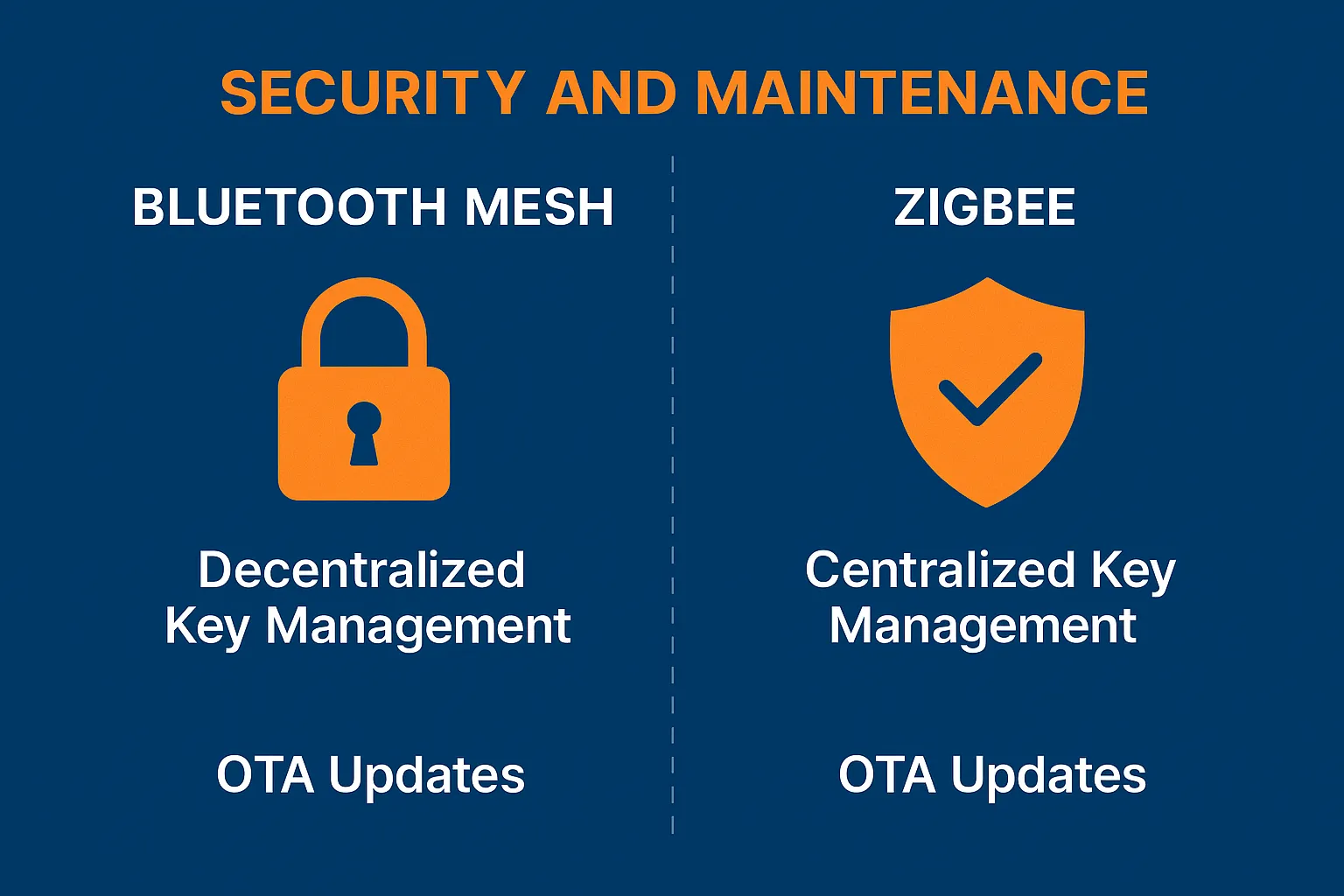
Both protocols use AES-128 encryption but differ in key distribution:
- Zigbee: Centralized key management by the coordinator. Ideal for enterprise environments but requires robust gateway security.
- Bluetooth Mesh: Decentralized key management — each device stores network and application keys locally. This reduces single-point-of-failure risks.
Firmware upgrades are increasingly supported over-the-air (OTA) by both systems. For example, Silicon Labs’ Bluetooth Mesh SDK allows firmware distribution to thousands of nodes simultaneously. (Silicon Labs OTA Docs)
Integration with IoT and Cloud Platforms
Zigbee
Because Zigbee typically connects via a hub, it integrates easily into cloud ecosystems such as Amazon Alexa, Google Home, 、および SmartThings. These gateways provide API access for large-scale remote management.
Bluetoothメッシュ
BLE devices connect locally and use a BLE-Wi-Fi bridge or gateway for cloud functions. The advantage is that Bluetooth Mesh networks can still operate fully offline if the Internet link fails, maintaining local control.
その Bluetooth SIG reports that 92 % of commercial Bluetooth Mesh lighting networks are used in “hybrid local-plus-cloud” configurations for reliability. (Bluetooth SIG 2023 Market Update)
Cost and Ecosystem Maturity

| ファクター | Bluetoothメッシュ | Zigbee |
|---|---|---|
| Module Cost (approx.) | $1.80 – $3.50 per unit | $2.50 – $4.00 per unit |
| Gateway Requirement | オプション | Mandatory |
| Ecosystem Vendors | 200+ (CSR, Nordic, Silicon Labs, Tuya, etc.) | 500+ (Philips, Osram, Tuya, Schneider, etc.) |
| Software Stack Cost | Often royalty-free (SIG) | Licensed or embedded via OEM partners |
| Time-to-Market | Shorter (uses standard BLE hardware) | Longer (certification, gateway setup) |
Sources:
For OEMs, Bluetooth Mesh can reduce hardware and certification costs while maintaining scalability for small- to mid-sized deployments. Zigbee remains dominant in enterprise and industrial lighting systems where management and integration depth outweigh component costs.
Real-World Examples

- Philips Hue (Zigbee): Over 100 million Zigbee-based bulbs deployed globally (Signify Annual Report 2023).
- Casambi (Bluetooth Mesh): European commercial lighting leader with over 1 million networks across retail and architectural projects (casambi.com).
- Tecolite Smart Series: Uses Bluetooth Mesh control for GU10 and MR16 LED bulbs to simplify commissioning without additional hubs.
Environmental and Energy Efficiency Implications
Efficient communication protocols directly impact overall system power draw.
- Bluetooth Mesh’s low packet overhead and sleep scheduling reduce control-network power consumption by up to 30 % in small installations.
- Zigbee’s routing overhead increases power slightly but remains efficient in large multi-hop networks.
As lighting accounts for nearly 15 % of global electricity use, adopting efficient wireless controls supports corporate sustainability goals. (IEA Lighting Efficiency Report 2022)
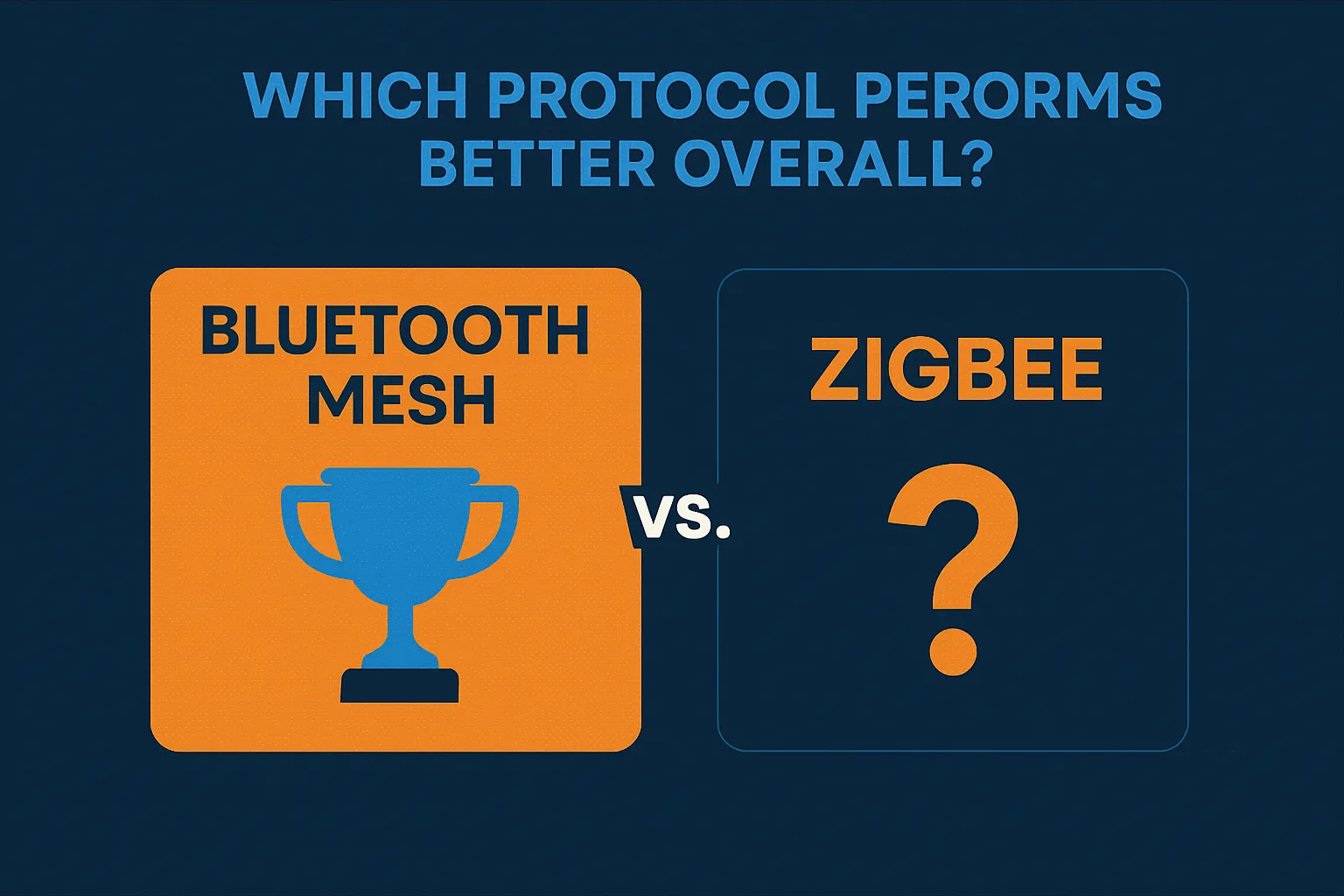
Which Protocol Performs Better Overall?
| カテゴリー | Winner | Notes |
|---|---|---|
| Ease of Deployment | Bluetoothメッシュ | No hub, smartphone commissioning |
| Large-Scale Management | Zigbee | Better for enterprise networks |
| Latency / Response Time | Bluetoothメッシュ | Faster scene transitions |
| Ecosystem Size | Zigbee | Established vendor base |
| コスト効率 | Bluetoothメッシュ | Lower hardware & setup cost |
| Cloud Integration | Zigbee | Native via gateway APIs |
| Offline Operation | Bluetoothメッシュ | Full control without Internet |
| エネルギー効率 | Bluetoothメッシュ (slightly) | Lower packet overhead |
Verdict:
- For retrofit and small-to-medium commercial lighting, Bluetoothメッシュ offers simpler deployment, lower cost, and faster control.
- For large multi-building or centralized enterprise networks, Zigbee remains the preferred choice for robust routing and system-wide management.
Future Outlook: Matter and Unified IoT Standards
Both Zigbee and Bluetooth Mesh are expected to coexist under the emerging Matter protocol (developed by the CSA). Matter uses IP-based communication and bridges existing ecosystems — including Zigbee and BLE — to provide seamless smart-home and commercial interoperability. (CSA Matter Overview)
Manufacturers investing today in BLE 5.0+ and Zigbee 3.0 hardware are already future-proofing their designs for Matter compatibility, ensuring long-term interoperability.
Conclusion: Making the Smart Choice
Both Bluetoothメッシュ そして Zigbee deliver reliable, efficient, and secure wireless control for LED lighting systems. The better option depends on your project size, network complexity, 、および user interface requirements.
For lighting manufacturers producing retrofit bulbs like GU10, MR16, or AR111, Bluetoothメッシュ provides the most practical path to smart connectivity — fast setup, smartphone control, and hub-free deployment.
For large-scale B2B projects such as commercial campuses or industrial plants, Zigbee remains a trusted workhorse with mature management tools.
Ultimately, the most effective approach may be a hybrid model — combining both protocols under unified Matter or cloud frameworks, enabling maximum flexibility, scalability, and user satisfaction.
Whether you’re designing smart bulbs, retrofit modules, or connected lighting fixtures, understanding the differences between Bluetooth Mesh and Zigbee is key to building scalable and reliable solutions.
At テコライト, we specialize in designing and manufacturing smart LED bulbs — including GU10, MR16, and AR111 models — that integrate seamlessly with both Bluetooth Mesh and Zigbee ecosystems.
Our engineering team helps OEM partners and distributors develop energy-efficient, standards-compliant products ready for Energy Label 2.0, Ecodesign, 、および Matter future compatibility.
Visit tecolite.com to explore our smart-lighting solutions or contact our sales team to discuss customized wireless control options for your next project.